What the picture shows
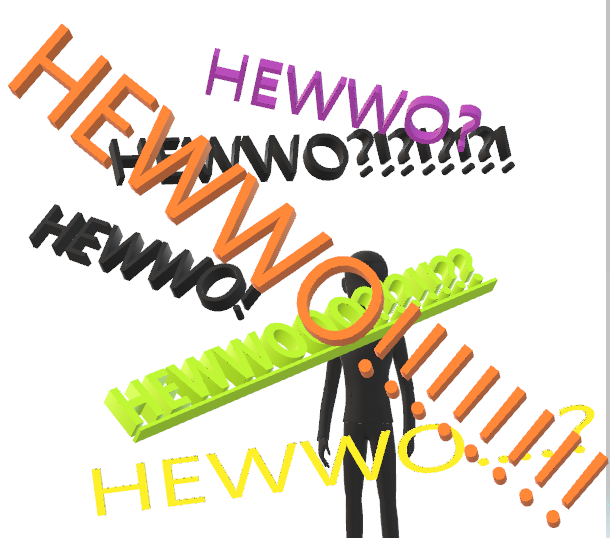
On a white background is a three-dimensional composition of the word HEWWO. The largest word is orange: it is tilted, crosses the whole picture diagonally, and is accompanied by a row of exclamation marks. Over and behind it are black words with question and exclamation marks, a purple HEWWO with a question mark, a thin yellow line with an ellipsis, and a light green flat “slab” with text lying at an angle.
At the bottom center stands a dark silhouette of a person with no face or details. Letters fly around it and partly cover the figure. The result is a chaos of greetings in which the person ends up inside an imagined shout. The composition looks like a clumsy render from a simple 3D editor, and this carelessness strengthens the comic effect.
What the spelling means
Hewwo is a way of conveying childish or deliberately baby-talk speech in writing. The sound l is replaced by w in this manner, and the word sounds like “hewwo.” In Russian-speaking chats and memes it is used to give a phrase a tender or playfully childish tone. The word has no independent meaning of its own: it works as a marker of intonation.
It is known that an entry with this meaning appeared in a dictionary of informal vocabulary on May 26, 2006, where it described a variant of the word hello. Reportedly, another early example is a quote from a magazine article in which a character speaks in a similar way, but the year and circumstances of that quote remain unconfirmed. The word has no single author: it existed as a joke long before the meme.
How the word became a meme
Tumblr played a major role. A post from October 26, 2016 with this word gathered more than thirty-five thousand notes. The real surge came in July 2017: the word moved into shitpost posts, where it was said in the most inappropriate situations. Jokes in which characters walk into dangerous places and say “hewwo” were popular. The reaction was mixed: some users enjoyed it, and others were irritated.
The growth of interest cannot be traced to a single post: about nine months passed between the 2016 entry and the July 2017 wave, and the reasons for that gap are unknown. For that reason, the story is better described as a gradual spread within one community.
Caption examples
The captions were written for this picture. In each one, a cute greeting collides with ordinary anxiety.
“Hewwo, who ate the last donut from the fridge?” The childish delivery makes the accusation soft, almost innocent. The contrast between baby talk and a serious question creates the joke.
“Hewwo, Monday. I'm back again.” A cute greeting immediately runs into weariness at the start of the week. The viewer expects joy and gets gloom instead.
“Hewwo, the Wi-Fi went down again.” A household complaint sounds like an address to a little friend. The effect rests on a mismatch of scale: a technical problem is presented with childlike delicacy.
“Hewwo, this is the tax office.” An official institution speaks in a childish voice, and a frightening topic sounds almost tender.
How to use the picture
The picture and the word suit posts with chaotic energy: announcements, jokes about deadlines, short lines in a discussion. For serious messages, the effect will be the opposite, so it is better to choose phrases where a playful tone is appropriate.
The word needs no explanation, but it should not be turned into a rule: replacing one letter works only when the rest of the text also sounds childlike. Otherwise it reads as a typo rather than a meme. For maximum effect, a single “hewwo” at the start of a line is enough, and the rest of the text can be ordinary.