Family dinner in The Affair
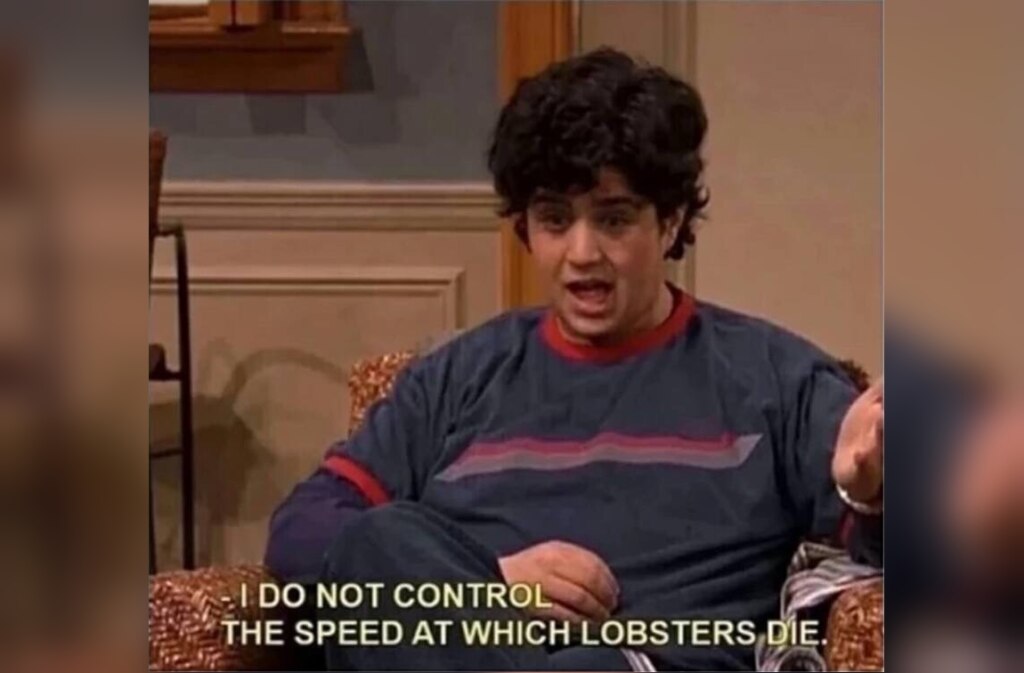
“The Affair” is the fifth episode of season three of Drake & Josh, dating to 2005. The brothers mistakenly suspect their father of having an affair, and at home they cook a dinner with lobsters. Josh Peck plays Josh Nichols, who answers a question about cooking time.
In the still, Josh says: “I do not control the speed at which lobsters die,” meaning “I don't control how fast lobsters die.” He sits with his mouth open and raises a palm, as when explaining or objecting. The subtitle holds the exact words, and the gesture helps imagine them as part of a conversation that continues beyond the frozen frame.
From repetition to text remakes
The screenshot spread in 2017 as an anti-joke: the caption repeated the words on screen, and the literal answer itself became the punchline. The funny effect came not from a new twist but from the complete match between the line and the caption.
Later the words began to be covered or replaced, assembling new sentences from a recognizable set. In such a version the reader first takes in the new wording and only then notices the familiar structure of the original line. The first form depends on repetition, the second on comparing the original with the changes.
Why the literal answer works
In an ordinary conversation, a question about whether food is ready calls for an estimate of time or a promise to check. Josh answers in a narrower sense: he doesn't control the natural process the dinner depends on. The precision sounds excessive relative to a simple request and turns an everyday dialogue into absurdity.
In the series the line is tied to dinner and the family's conversation; the meme keeps only one speaker. The interlocutor's question can be replaced while keeping Josh's answer. At the same time, the specific lobsters make the explanation unusually narrow: the phrase promises a universal excuse but ends with an object that doesn't fit most everyday conversations at all. The clash between a general beginning and a particular ending sustains the absurdity even without knowing the episode.
Examples of invented captions
The examples were invented for this article. Heading: “When a colleague asks why the file is still loading.” Caption: “I don't control the speed at which the server processes the request.” Here a concrete work task gets an overly precise answer instead of a promise to check the status.
For a variant with closed captions one can compose “I control speed” (“I control the speed”). If you hide the negation and the lobster details, the explanation of limited capabilities turns into a confident claim of power. The photo stays the same, but Josh's familiar answer becomes almost bragging. A reader who remembers the original notices the change of meaning before restoring the missing words.
“When someone asks why the bus hasn't arrived yet.” Caption: “I don't control the speed at which the traffic light releases the vehicles.” A few minutes of waiting get a detailed explanation of others' processes. The image suits a person who answers confidently while being unable to help the waiting person with that answer.