Training visit on March 19
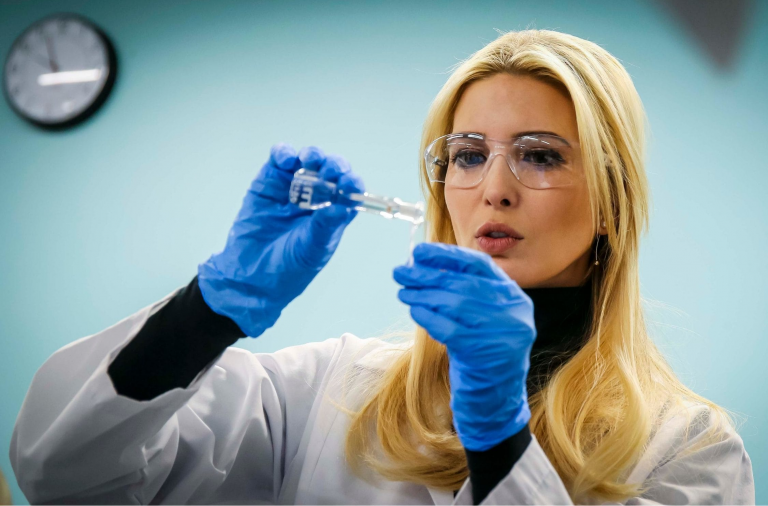
On March 19, 2018, Ivanka Trump, then an adviser to the President of the United States, visited a training center in Waukee, Iowa. The visit was connected to workforce preparation and introducing participants to hands-on activities. The center combined teaching schoolchildren with the needs of local businesses. In the laboratory, guests were shown an experiment for determining the nicotine content of liquid for e-cigarettes.
The next day, the photographs were widely discussed online. Ivanka was compared with an actress playing a scientist and with characters from staged illustrations about science. The meme title emphasized the impression created by her clothing and pose. The visit itself remained a visit to a training site: it did not mean an appointment to a research position, and the laboratory scene said nothing about any discovery.
A pipette instead of a microscope
In the frame, Ivanka wears a white lab coat over dark clothing, with long light hair, clear safety goggles and blue gloves. The hand on the left of the image holds a pipette aimed at a small vessel in her other hand. Her mouth is slightly open, and her attention is focused on the objects. Behind her are light blue walls, laboratory equipment and a clock in the upper left corner.
These details immediately set up the category of “laboratory experiment.” Recognition does not require understanding how the instruments work: the coat, the goggles and the careful work with the hands already form a familiar visual image of science. That is why a caption can change the scale of what is happening so sharply. Instead of a complex analysis, the viewer reads about preparing a soluble drink, and the photo's unchanging seriousness makes the substitution especially noticeable.
Expert pose and the language of instructions
One way of remaking the image is to describe a simple action in the most solemn terms. A person adds water to a cup, but the caption reports managing the concentration of a solution. The joke is not that the laboratory work is unnecessary, but the gap between its outward complexity and the new, deliberately modest content. The photograph provides a convincing form for verbal exaggeration.
Another variant concerns the image of competence. The meme portrays a participant who has learned a few terms and now confidently explains the workings of the world to friends. The viewer compares the serious gaze with the superficial reasoning in the caption. The scientific props strengthen the persuasiveness of such an explanation, even though its content deliberately stays trivial. It is precisely this shift of context that turns a photo from a visit into a universal scene of showing off knowledge.
A laboratory for very simple tasks
The following situations are fictional. First caption: a person measures out the exact amount of syrup for homemade lemonade because yesterday they poured it by eye. The pipette symbolizes an unexpectedly strict approach to an ordinary drink. The more mundane the goal, the funnier the equipment of the imaginary research looks.
In another invented example, a player explains a new system for calculating luck to friends after a single win. They did not change their strategy, but they use words about variables and probability. The photo expresses the solemnity of the explanation, while the short caption reveals its weak foundation.
The third fictional scene is preparing plant food for a houseplant according to the instructions on the package. The person measures every drop, checks the volume of water and records it in a notebook. The meme gently exaggerates the attentiveness of a beginner gardener: a small household chore turns into an event that supposedly required a separate scientific center.