What the image shows
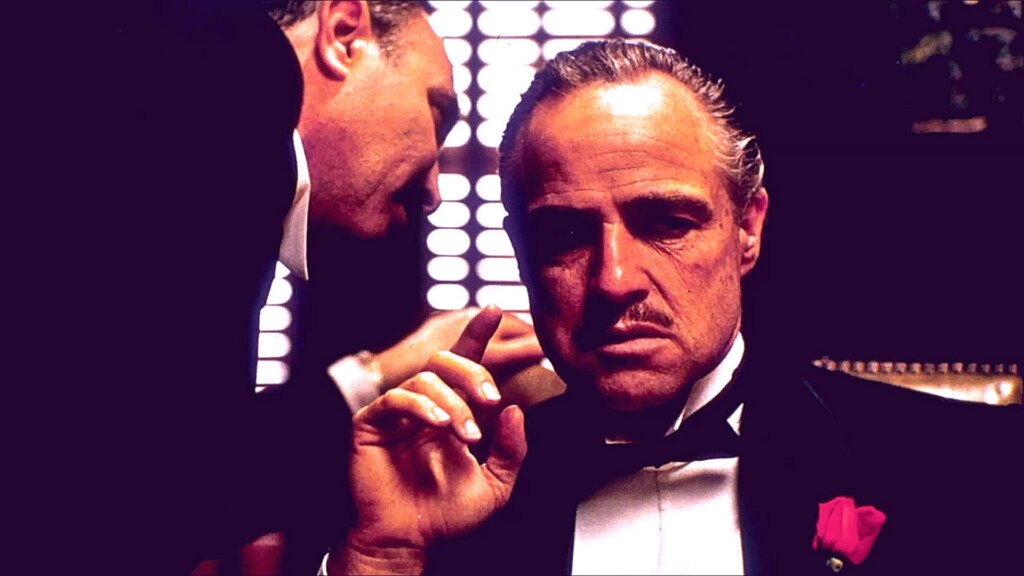
At the center of the frame is Marlon Brando in a tuxedo with a pink carnation in his buttonhole. The carnation serves as a detail that underscores the character's status and makes the scene more solemn. The character sits in semi-darkness, raises a hand with his fingers folded together, and looks toward the person he's speaking to with a focused, slightly displeased expression. Next to him another man is visible, leaning in close to his face, which creates the atmosphere of a secret conversation in which important matters are being decided.
The dark background, soft lighting, and expressive face make the frame recognizable even without a caption. It's exactly this kind of scene that serves as the basis for image macros, where text above or below assigns a new meaning, often unrelated to the plot. The viewer sees the familiar don and is immediately ready to accept any line delivered in his intonation.
Origin
The film The Godfather was released in 1972, directed by Francis Ford Coppola, based on Mario Puzo's 1969 novel. Marlon Brando won an Academy Award for Best Actor for the role of Don Corleone, and the film itself became one of the main symbols of American cinema.
The meme is built on a line from the film's opening scene, in which Bonasera asks the don to avenge his daughter, and the don reproaches him for making the request without due respect. The exact author of the first image macro and the date it first appeared are not established in open sources, but in the Russian-speaking internet this series became fixed as a standalone format, with text updated to modern, everyday speech.
How the meme is used
Brando image macros are used when someone needs to deliver an ironic scolding or remind another person about the rules of politeness. A caption along the lines of "you ask for help, but you do it without respect" is usually addressed to someone who writes rudely, demands an immediate reply, or shows up with a request without saying "please."
Sometimes the format is used for joking takedowns of everyday conflicts, from requests to borrow money to demands to take out the trash. The gravity of the frame makes any text weightier than it actually is, so even a minor reproach sounds like a sentence handed down in a dark room. It's exactly this contrast that becomes the source of the humor.
Why the meme works
The joke rests on incongruity. The film's grim solemnity and Don Corleone's manner contrast with the petty everyday situations that, in the caption, come to look like mafia business. The viewer recognizes the character's intonation and immediately understands that this is a parody rather than a real threat. It also matters that the humor works on recognition: people aren't laughing at the text, but at how far the film's tone is from the mundane situation.
The second reason is the recognizability of the frame. Brando's image in a tuxedo is among the most quoted in film history, and it reads without any explanation needed. That's why image macros using this frame are understood even by those who have never seen the film, and they survive the turnover of generations of internet users. In addition, the format allows gravity to be used as a tool: the very same phrase can sound serious or mocking, depending on the caption placed under the frame.