White letters on a black background
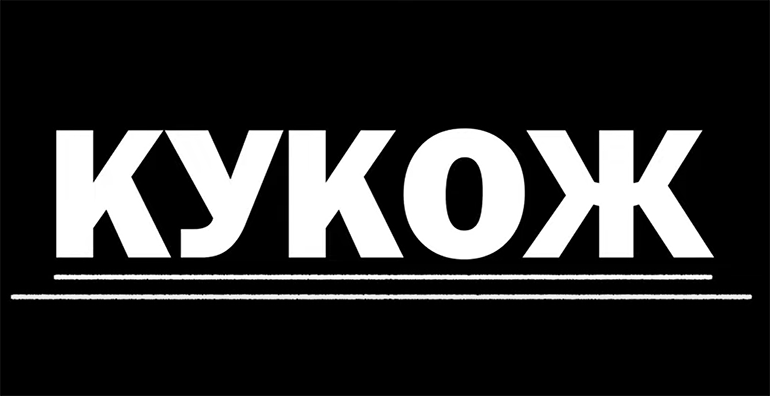
The picture is extremely simple: a black rectangle, with the word "KUKOZH" written in large white capital letters at the center, and below it two thin white lines, the second longer than the first. There are no characters or scenes, so this isn't a template frame but a title card. Memes love this kind of flat delivery: the word looks like a sign or the title of a documentary, and that seriousness is exactly what makes it funnier.
Where the word comes from
According to language breakdowns, "kukozh" is a calque of the English "cringe," which comes from a verb meaning "to shrink back." The Russian word echoes "skukozhitsya" — to curl up, to wrinkle up — and that association makes the meaning clear without any translation needed. The stress usually falls on the second syllable: kukOZH.
The word's appearance is dated to 2019, amid debates about borrowed words creeping into youth slang. No exact author or first use has been found, so this dating should be taken cautiously. Popularity came later: the word caught on a couple of years afterward, once memes and hashtags sprang up around it. It isn't in dictionaries yet, but it's already spawning derivatives like "kukozhny" (cringe-ish).
How kukozh differs from cringe
The meanings are nearly identical: both words describe secondhand embarrassment over someone else's actions or an awkward situation that makes you want to shrink away — hence the echo of "curling up." But the flavor is different. "Cringe" has long since become a neutral, mainstream word for awkwardness, while "kukozh" is more often said deliberately for laughs, with exaggerated seriousness, playing on the very attempt to replace a loanword with a "Russian" one. Using it instead of the familiar "cringe" is a way of signaling that you're speaking ironically and are in on this particular bit of wordplay.
That's how post-irony works: a person swaps a loanword for a "Russian" version not for linguistic purity, but to highlight the absurdity of doing so. That's why a single black poster with the capitalized "KUKOZH" functions as a ready-made verdict — it gets slapped onto any awkward story with no further words needed, and that same short title card reads equally well as a funny diagnosis and as a deliberately solemn, almost bureaucratic stamp.
Example captions
Invented examples. "My voice on the recording, once I finally heard it." The caption puts the word in the position of a verdict, and the contrast between the solemn poster and the mundane occasion is where the joke comes from.
"A congratulations in the family group chat at 3 a.m." Kukozh here describes the timing and format, not a person.
"When the other person said 'wow, you don't say' and went quiet for a minute." Pauses are the main source of awkwardness here, and the word stands in as the summary.
"A presentation where I try to crack a joke." Self-deprecation makes the joke safe and easy to read.
How to use it
Visually, the poster resembles a title card or a memorial plaque, and that's part of the device too: the bulky, almost solemn presentation turns an everyday awkward moment into an event worthy of its own announcement. The smaller the occasion, the stronger the effect. For example, caption the poster with words about someone's joke that nobody appreciated, and the reader will instantly picture the silence in the room.
The picture works well as a reaction when someone in a chat tells an awkward story, or as a heading for a roundup. It's better not to caption it with real people's names: the word is judgmental, and aimed at a specific person it reads as mockery rather than play.