What the picture shows
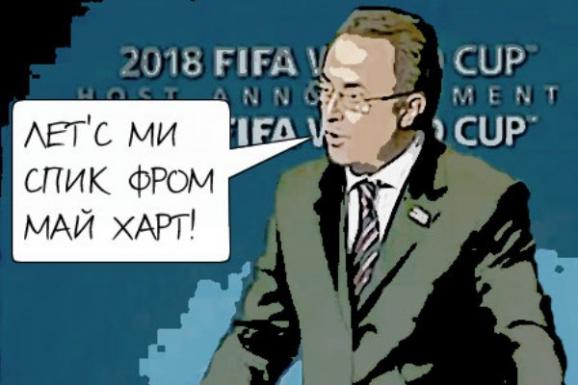
The picture shows a man in an olive-gray jacket and a striped tie standing on a stage. The image is drawn in a cartoonish, posterized style: sharp outlines, flat shadows, and a simplified face. Behind him is a blue backdrop with the words “2018 FIFA World Cup” and “Host Announcement,” partly covered by a speech bubble. This is the design of the ceremony announcing the host country of the tournament.
The speech bubble contains the text “Let's me speak from my heart!” written in Russian letters. This is what makes the meme recognizable: the phrase is read aloud in Russian, so the viewer immediately hears it as a pronunciation rather than as English. The text in the picture is a paraphrase of the speech in caption form, not an exact transcript of the address.
Where the phrase came from
In December 2010, in Zurich, the FIFA Executive Committee met to choose the hosts of the 2018 and 2022 World Cups. Russia was bidding for 2018. Mutko, then the minister of sports, addressed the committee members in English, and the opening of his speech took on a life of its own.
The speech became a source of mockery: the accent and the sound of the phrase spread across the internet in Russian transliteration. Later, publications often recalled his English, and the meme settled in as a short name for situations where a person takes on a foreign language with more confidence than their practice can support.
What Mutko himself said about the speech
According to reports, he later explained that he had prepared the speech for about two weeks, and mentioned that the English text had been written in Cyrillic so he could read it more confidently. The details and wording vary across different publications, so they cannot be quoted word for word.
For understanding the picture, this matters: the meme kept the part of the story that viewers found funny, and does not claim to retell the event in full. The rest, including the outcome of the vote, has nothing to do with the joke.
Caption examples and how they work
“When colleagues suggested we skip the interpreter.” The caption sets up an expectation, and the speech bubble in the picture answers it: the viewer already knows an awkward phrase is coming and laughs at the match.
“Promised a presentation in English and now I'm speaking from the bottom of my heart.” Here the phrase from the meme works as an apology. The expression “from the bottom of my heart” sounds touching, but next to the Russian transliteration it becomes a parody of the speaker's own confidence.
“Ordering at a restaurant where the menu is only in English.” The caption moves the template into an everyday situation, with no stage and no bid, just a simple need to make oneself understood. The contrast between the solemn frame and the ordinary task is what makes the caption funny.
In all three examples, the caption describes the situation, not the man in the picture. The speech bubble stays the same, so the meaning depends on the story the text above the phrase tells.
Why the phrase outlived its occasion
The funny element here is the contrast between the official setting (the tournament emblem, the stage, the suit) and the everyday awkwardness of the language. The audience expects a measured speech and gets a phrase that is understandable by ear but sounds absurd. That is why the meme travels easily to any situation where a person confidently takes on something they are weak at.
It is useful to keep the limits of the story in mind. The words of the speech are known from retellings and interviews, while the judgment of how funny it sounded belongs to viewers. The picture shows a scene and a caption, but it does not prove that the speaker knew about the future joke at that moment. Jokes are easier to build around one's own language failures than around someone else's: that keeps the meme good-natured rather than malicious.