What the picture shows
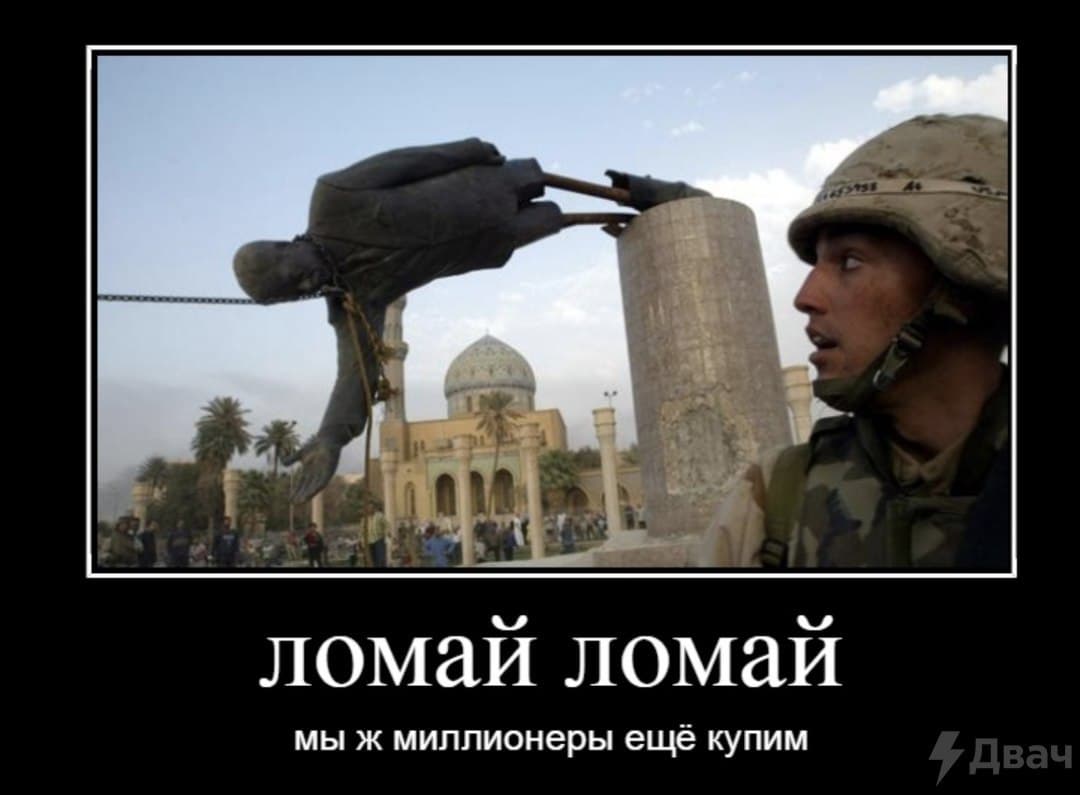
This is a demotivator: a black frame, a photo, and two lines of white text at the bottom: the large “Break it, break it” and, smaller, “we’re millionaires, we’ll buy more”. In the photo a dark statue is toppling sideways, wrapped in a chain or cable, and metal pins remain on the pedestal. On the right, a soldier in a helmet and camouflage is clearly visible, looking at the falling figure with a tense, almost surprised face. Behind him are a building with a dome, palm trees and a small crowd.
The photo most likely relates to the toppling of the statue of Saddam Hussein in Firdos Square in Baghdad on 9 April 2003. Who took this particular photograph could not be established, so no author is named. For understanding the joke, the author is not important.
A phrase from childhood
The basis of the meme is an everyday remark that, as is commonly believed, many people heard in childhood: when a child dropped or broke something, the mother would say sarcastically, “Break it, break it, we’re millionaires, we’ll buy more.” The phrase expresses a reproach hidden behind a show of permission.
The joke has lived in the Russian-speaking internet for a long time and usually accompanies pictures of something falling or breaking. The exact time this particular demotivator appeared is unknown.
Why the demotivator works
The phrase is ironic in itself: nobody breaks things because they are rich, and the speaker is in fact showing that there is no money to replace them. When this phrase is placed under a photo of grandiose destruction, the scale of the joke jumps: from a household trifle it becomes a dry comment on an event that is hard to judge in one word.
Importantly, the demotivator doesn’t explain who “we” are or what “buy” refers to. Each viewer fills in their own: a household, a state, a company. This openness is what the authors of such pictures value, though it has a downside: the subject of the photo is serious, and the caption can easily be read as mockery of real events.
Captions in the same vein
“Kids, while the parents are at the store, and the vase is on the floor.” The phrase returns to its original domestic meaning, so the picture should be chosen to match.
“Furniture assembly, step 7 of the instructions.” The caption sets everyday life against a dramatic image: the destruction looks grandiose, though in reality it is just a wardrobe.
“When I tried to tighten a nut without a wrench.” The joke is that the person in the picture is trying to manage without the right tool, and the mother’s phrase serves as the verdict.
“An IT guy deletes a table in production.” A professional version: the phrase means the mistake was costly and the consequences will have to be fixed.
Tips and caveats
If you do use this particular picture, remember that it resembles a real historical event with a political context. For everyday jokes it is simpler to take a neutral image: falling dishes, a broken toy, a shattered screen.
The phrase itself is universal and usually sounds better without embellishment: it is enough to show the result of the breakage and add the saying in one line. Long explanations only weaken the joke: the viewer already hears the mother’s intonation.