What is visible in the photo
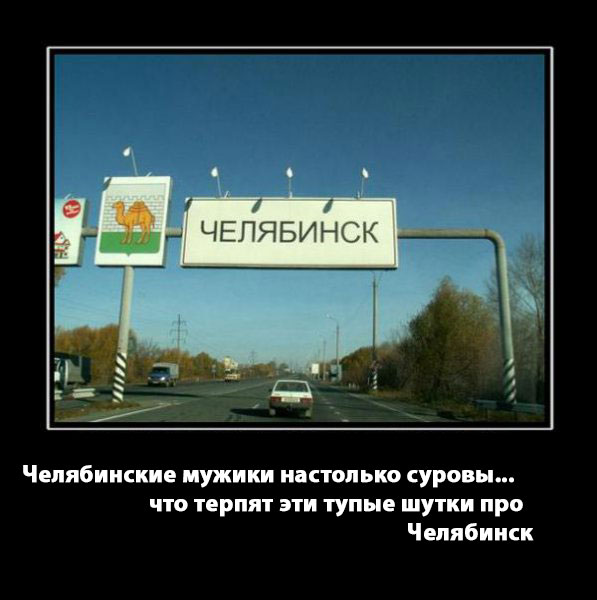
The picture is made as a classic demotivator: a black frame, a photo on top and a caption in light type on a black field at the bottom. The shot was taken on a highway. Above the road, on a gantry, hangs a large sign reading “CHELYABINSK,” and on the left, on a separate board, a coat of arms is visible with a yellow camel on a green and white field. Trees with yellow-brown leaves line the roadside, the sky is blue, and in the distance a light passenger car is driving along the road.
The caption consists of three lines: “The men of Chelyabinsk are so stern…”, “that they put up with these stupid jokes about” and the word “Chelyabinsk,” aligned to the right. The line break works as a pause: the last word arrives unexpectedly and flips the meaning of the first part.
Where the format came from
The exact origin of the format is not established, and the first author of the caption cannot be named. One can only speak of the general background: Chelyabinsk and its region have long been associated with the image of a “stern” place, with heavy industry, a harsh climate and tough-minded residents, and the memes simply pushed this image to hyperbole.
A noticeable boost to this kind of irony came in February 2013: on February 15 a meteorite exploded over Chelyabinsk, and a wave of jokes about how locals react to cosmic events appeared online. The caption on this picture belongs to the same kind of exaggeration, although it cannot be claimed that it appeared precisely at that time.
What the joke does with the image of the stern man
The main device here is exaggeration. The word “stern” is usually said of a person who calmly holds up under difficult conditions. Here it refers to a whole city, and the irony appears immediately: sternness now has to endure not the cold or the work, but other people's jokes.
The second half of the phrase unfolds the expectation. The reader expects a story about strength or heroism, but gets “put up with these stupid jokes.” Strength turns into endurance, and the laugh arises at that transition. The photograph serves as an anchor: the road, the sign and the car look completely ordinary, so the lofty statement sounds even more absurd.
The joke targets a stereotype about the city, not a specific person. The caption contains no names or personal details, so it is easy to read both as the residents' self-irony and as a general joke about regional character.
Caption examples and how they work
Below are four new captions for the same template. The opening “The men of Chelyabinsk are so stern…” stays, and only the continuation changes.
“The men of Chelyabinsk are so stern that they've already picked a name for the next meteorite.” The reference to the 2013 event gives a familiar context, and the phrase “picked a name” turns a cosmic catastrophe into a household task. The scale narrows at once, and the joke becomes funnier.
“The men of Chelyabinsk are so stern that when asked ‘what time is it?’ they answer ‘now.’” Here literalness does the work: the answer is formally correct and therefore absurd.
“The men of Chelyabinsk are so stern that the road sign by the highway asked their permission to stand there.” A personification device: an ordinary sign gets a role, and the eye returns to the photograph, which turns out to be part of the story.
“The men of Chelyabinsk are so stern that even the joke about Chelyabinsk apologized and left first.” Here the direction changes: the city is not the one enduring the jokes, the joke finds itself in an awkward position. The role inversion holds interest to the very end of the phrase.
How to use this template
For this format, three-line captions like the original photo's work well. The line break creates the pause, and it is better to keep it even when adapting the caption to another format. A short ending works better than a long one: if the continuation stretches over two lines, the pause is lost.
The photograph should remain ordinary: a city landscape, a road, a sign. If it is replaced with bright or large human faces, the joke shifts in a different direction and stops being a joke about a stereotype. The city theme is understood by locals and by those who know the 2013 story. For a broad audience, it is better to make the first line self-sufficient so that the meaning reads without references.
It is better to write captions in which the city appears more as a hero than as a target of mockery: residents' self-irony works more gently than jokes from outside. Avoid insults and comparisons that offend people based on where they live.