the visual transformation
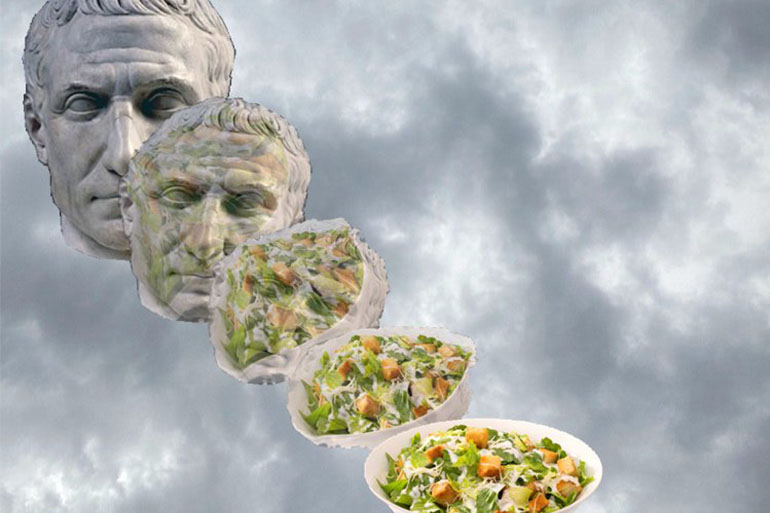
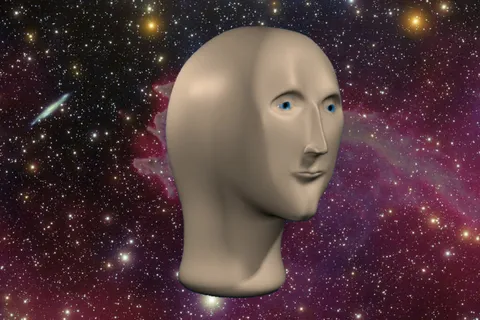
The image lines up several busts diagonally: a large white sculpture gives way to smaller heads, and the final stage turns out to be a bowl of salad. The progression hints at how a word and its referent can shift. The caption "People change" first sounds like a comment on someone's character or growing up, and then the picture delivers a literal transformation of a person into an object or dish.
Among the format's well-known examples is the jump from Napoleon Bonaparte to the Napoleon cake: one name, one matching dish. Other versions find a match through a surname, a nickname, or a word, and then build a sequence of images out of it. This particular image ends on a salad, but exactly which person it's meant to reference isn't labeled. One shouldn't assert a specific word chain if it isn't actually shown in the frame.
playing on double meanings
The joke starts with one meaning of a word and ends with another. The viewer expects "people change" to be about personal growth, but instead gets a surreal swap of a person for an object. The transition looks like a visual evolution, even though it's really built on a wordplay association. The more unexpected the final object, the stronger the comic effect. That's why authors often reach for food, household items, and other familiar objects.
This technique resembles a visual riddle: first a well-known figure or symbol is shown, then the viewer is nudged toward another meaning of the same word. Even without a caption, the sequence makes people hunt for the shared feature. If the overlap is obvious enough, the audience gets the joke; if not, the meme just reads as a pointless photoshop job. A caption can help the viewer along, but over-explaining it can rob the joke of its moment of discovery.
how to make your own version
To build a variation, find a name or word that also has an everyday meaning, then show the transformation in a few stages. For instance, a person's surname could be linked to a dish, a tool's name, or an object, as long as the audience gets the connection. The sequence should keep a visual logic to it — the object should gradually change rather than simply be swapped for a random picture. Shrinking the busts step by step creates a sense of a gradual transformation.
New captions can play on familiar names: "He started out as a great general and ended up as a dessert on the family table," or "People change — especially when their surname matches the name of a salad." These are examples of how to build the joke, not new facts about historical figures. It's important not to confuse the wordplay with actual biography: Napoleon never turned into food — only the visual association changes.
an edit, not a biography
The transformation in the image is done graphically and doesn't document any real change in actual people. The pictures of the sculptures and the salad are combined purely for the wordplay effect. The title "People change" might sound like a serious maxim, but here it becomes an ironic caption for the edit. That contrast between a philosophical-sounding tone and a ridiculous punchline is what makes the format recognizable across new versions.
The meme has circulated in various editions, with the final object sometimes being a light bulb, a car, a dish, or something else entirely. This image shows one such chain; the exact author and creation date can't be established. When describing it, it's useful to talk about the wordplay technique and the visual substitution, without claiming that one specific person started every variation. That keeps the conversation about the wordplay — Napoleon and the cake, a surname and a salad — rather than about an invented biography for the person in the bust.