The event in Parliament
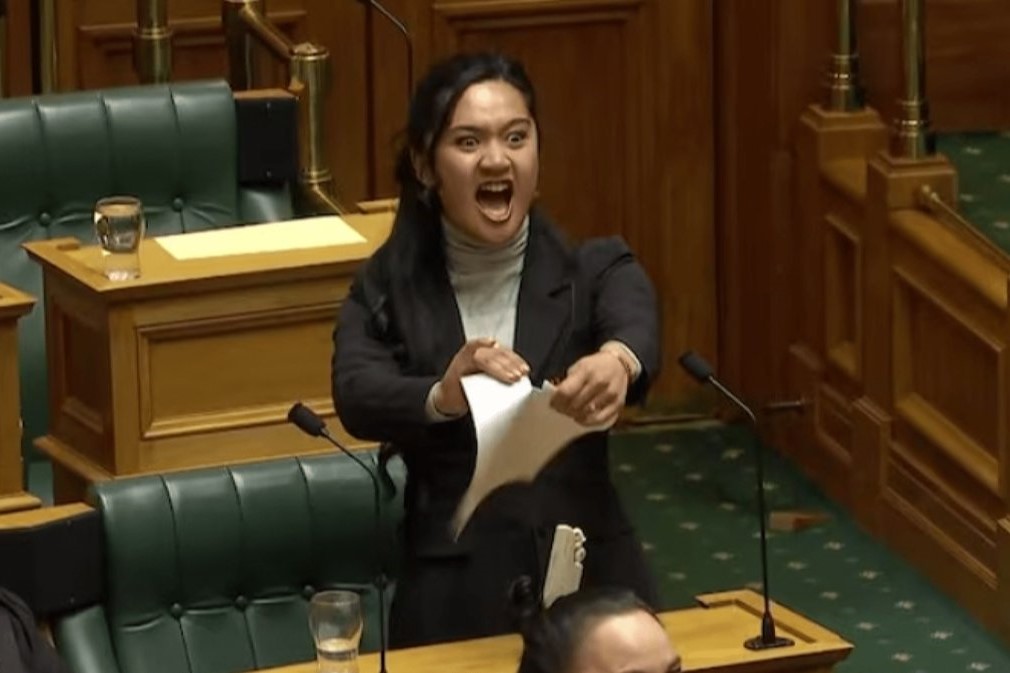
On November 14, 2024, the House of Representatives of New Zealand debated the Treaty Principles Bill. The proposal was meant to enshrine certain principles in legislation and their role in interpreting laws. During the first-reading vote, Te Pāti Māori MP Hana-Rawiti Maipi-Clark stood and began to perform the haka Ka Mate; other MPs and gallery visitors joined her. The sitting was interrupted, and the bill was later defeated at its second reading.
Haka is not one specific dance or simply a "war cry": it is a general name for Māori forms of collective performance that can accompany different events and express belonging, greeting, sorrow, or protest. In this case the performance was a political objection to the bill. To understand the image, it is important to see in it not an abstract flash of anger but part of a public parliamentary action around the treaty and its interpretation.
What appears in the photograph
At the center of the image is Maipi-Clark in the parliamentary chamber. She stands between rows of seats, holding papers and speaking with her mouth wide open; tables, microphones, and other participants are visible around her. This is a moment of speech, not a posed portrait. The facial expression and gesture read clearly as determination and vocal protest, but the photo itself does not tell the whole story of the vote and does not replace an explanation of what the MPs were objecting to.
In memes, such an image can mark the moment when someone stops staying silent and directly objects. However, turning the haka into a universal joke about any loud reaction would be a simplification. The image connects to a specific cultural tradition and political context, so a respectful caption keeps its respect for the event: for example, it makes a joke about one's own determination, bureaucracy, or an overly tangled rule, without mocking Māori people or their practices.
How the meme took on its meaning
The video of the session spread widely because the short clip contains clear action: the MP stands, begins her statement, and those around her support her. The image is visually expressive and fits easily into a caption about resisting a decision or collective disagreement. Unlike many reaction memes, the original scene itself had a public purpose, and was not a chance capture of a grimace.
For example, a caption such as "When the team finally says a one-day deadline is unrealistic" moves the structure of collective objection to a work situation. The humor is aimed at an impossible deadline, not at politicians or culture. Another option—"Me explaining to the family chat why we can't change the plan ten minutes before leaving"—uses the image of a decisive statement to describe a familiar argument. A contextual caption tells the reader why the person in the image is speaking loudly, instead of ascribing some random absurdity to her.
Using the template and where the joke stops
The template suits a situation where a person or group defends an important boundary, corrects an unfair rule, or demands to finally be heard. A strong version usually builds on the contrast between a solemn image and a small everyday problem; gentle self-irony helps avoid devaluing real protest. For example: "When the meeting proposes, for the fourth time, a solution that has already failed three times"—the caption pokes fun at a recurring mistake, not at the tradition itself.
Do not use the image as though haka were a synonym for rage, threat, or uncontrolled noise. The performance took place in Parliament and had a specific reason. The bill was also defeated at its second reading, but that does not settle the complex debate over the Treaty of Waitangi: a short meme cannot explain all positions. If a caption requires the event's history, it is better to leave the image in the context of a protest performance and choose a neutral everyday example.