A news item turned into a local language
On May 21, 2018, reports appeared about a ranking compiled by the marketing agency Zoom Market based on survey respondents' answers. Perm was placed at the top. The headline proved convenient material for jokes: the city received an easily reproducible characteristic that could be transferred to greetings, school lessons, road signs, and everyday conversations. The news was discussed alongside disputes about the study itself, but the memes needed only the short formula about first place.
Already on May 22, a “Russian-Perm dictionary” circulated on social networks, in which ordinary expressions were matched with profane equivalents. Other versions followed on VKontakte and beyond that platform. The ranking served as a pretext, and then the authors independently built out the funny image of the city. Therefore the history of the format is tied to a specific news item of spring 2018, although some pictures depict situations that did not appear in the survey at all.
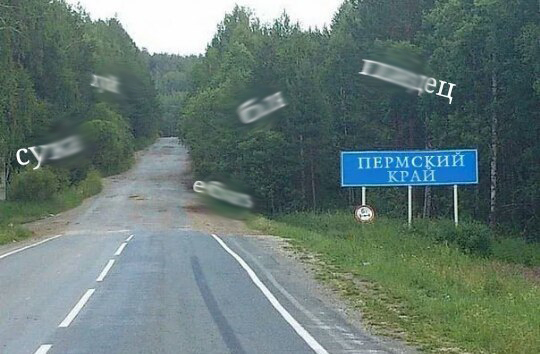
Words flying over a forest road
The image shows an asphalt road running between trees, and on the right stands a blue sign reading “PERM KRAI.” Over the photograph are white fragments of words, slanted and blurred as if rushing past the camera. Some letters can be made out; others are lost in the blur. The result is a conventional arrival scene: the traveler has not yet seen a settlement but has already entered a stream of a special speech. The regional sign extends the urban news story to an entire territory within the joke.
Speech becomes weather
In an invented version, a tourist opens a guidebook and finds a section “Basic Phrases.” Next to a polite “Could you tell me the way to the museum?” stands an excessively emotional “local” version of the same phrase, stretched over half a page. The next line explains that even a polite “thank you” here turns into a whole paragraph of emotion. The humor lies in the disproportion between an everyday task and the linguistic picture: the guidebook promises to help you get your bearings but instead turns an ordinary walk into training in an unusual vocabulary before visiting the museum.
The blur adds a sense of motion and helps imagine the picture from a car window. The author does not need a long conversation: the sign names the place, and a few words instantly explain the peculiarity of the invented space. By the same logic, in other versions ordinary phrases turn into a “local translation.” This is the language of news parody, which exaggerates a single message; the photograph of a road by itself says nothing about the real speech of each resident.
An imaginary guidebook
In an invented version, a tourist opens a guidebook and finds a section “Basic Phrases.” Next to a polite “Could you tell me the way to the museum?” stands an excessively emotional local translation taking up half a page. The next line explains that even gratitude here sounds like an argument with a navigator. The humor lies in the disproportion between an everyday task and the linguistic representation. The guidebook promises to help you get your bearings but in fact turns an ordinary walk into training in an unusual vocabulary before visiting the museum.
A quiet sound beyond the regional border
Another invented plot is built on a road scene: a passenger enters Perm Krai, and the navigator's voice suddenly becomes expressive. Instead of the usual “in three hundred meters, turn right,” comes a far more emotional version of the same phrase. On the return trip the device again speaks calmly and officially. This variant develops the same device as the flying words in the picture but adds a small sequence of events: the geographic border seems to govern the style of speech even for a program that should only tell you the distance to the next turn.