A news item that quickly became a household joke
In spring 2018 Russian gasoline prices rose noticeably, and in late May the topic got a new wave of discussion. News coverage of the time cited Rosstat statistics, describing the acceleration of growth in the week of May 21–27 and different prices in different cities. Reactions in late May and early June turned this news into familiar meme images: the cost of fuel became an explanation for disappointment, thrift, and forced changes of plans.
The phrase “45 rubles” is handy for its brevity. Behind it fit the costs of the daily commute, a trip out of town, and filling up before a journey. The number in the caption does not mean that a single tariff applied across the whole country: it conveys a specific historical conversation about the price hike. The wave had no single main character. One author might take a surprised face, another a scene of poverty, and a third a passenger who had already adjusted to the new expenses.
The passenger has already found his answer
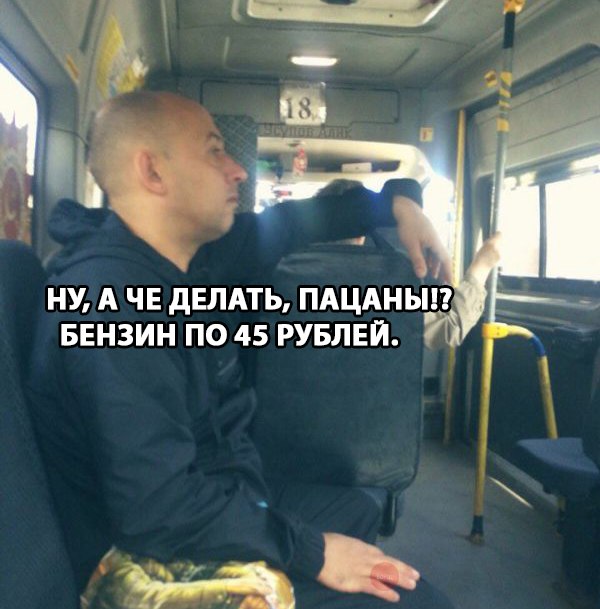
The photograph shows a man with short hair sitting in public transport. He wears a blue jacket, and his elbow rests on the back of the neighboring seat. Behind him are windows, yellow handrails, and another passenger. White letters with a dark outline fill the lower part of the frame: the hero seems to be answering his buddies about why he is here, citing gas at 45 rubles.
The man's name and the circumstances of the original shoot are not known; the meaning comes from the added caption. The photo shows neither a gas pump nor a price tag. It shows an alternative to the car that has already been chosen. The calm seated pose suits the short “So what can you do?”: instead of a stormy protest, the viewer gets an everyday scene in which the unpleasant news has already become part of the usual route.
Why the excuse is funnier than the sum
The caption sounds like a reply to an unseen question. The friends seem to have expected to see the man behind the wheel, and he explains his presence on the bus in advance. The address “guys” makes the line conversational; the price supplies an understandable reason. Such a small imagined dialogue brings the photo to life. The hero acquires a backstory beyond the frame: there were other plans, they had to be revised, and now he just has to announce it without long reasoning.
The comic effect joins two scales. News about the fuel market seems big and abstract, but in the picture it boils down to a seat in a vehicle. Instead of a table, the viewer sees the consequences in a single trip. At the same time the meme allows both sympathy and self-irony: a person may recognize his own expenses or laugh at how quickly the recent habit of driving everywhere has turned into a luxury for the occasional trip.
The trip in the new version of the budget
In an invented variant, the caption reads: “We wanted to meet at the other end of the city, now we're meeting at the next stop.” The shrinking scale of the adventure is what's funny. Another invented story shows friends who planned a road trip but are studying bus route maps in detail. The price here becomes a plot twist: the company keeps the wish to go somewhere, but its idea of the road changes sharply.
The same technique can be applied to another price hike. Under the passenger photo appears the phrase: “A taxi asked so much that I decided to get to know all the stops.” The specific service changes, but the familiar logic stays: the hero calmly chooses a cheaper way to get around. The historical gasoline version is distinguished by the sum of 45 rubles and its link to the 2018 discussion; the later remake uses not that news but the language of everyday resignation it left behind.