How a news word entered the jokes
On March 4, 2018, Sergei and Yulia Skripal were poisoned in Salisbury, Britain. On March 12, Prime Minister Theresa May spoke in Parliament and said the substance used belonged to the “Novichok” group. The British government linked the incident to Russia. Two days later May announced measures that included the expulsion of 23 Russian diplomats; British representatives were expelled in return. The news story quickly grew into a diplomatic conflict with regular statements and discussions.
In Russian-language social media, the name itself became especially noticeable. An ordinary word meaning an inexperienced participant suddenly appeared constantly in reports about secret developments, investigations and international relations. In March 2018, puns, reworked images of politicians and parody packaging appeared. Some versions mocked the tone of official statements, others played on the double meaning of the name or combined it with recognizable Russian symbols. The memes are tied to discussion of the event, and individual montages express the positions of their authors.
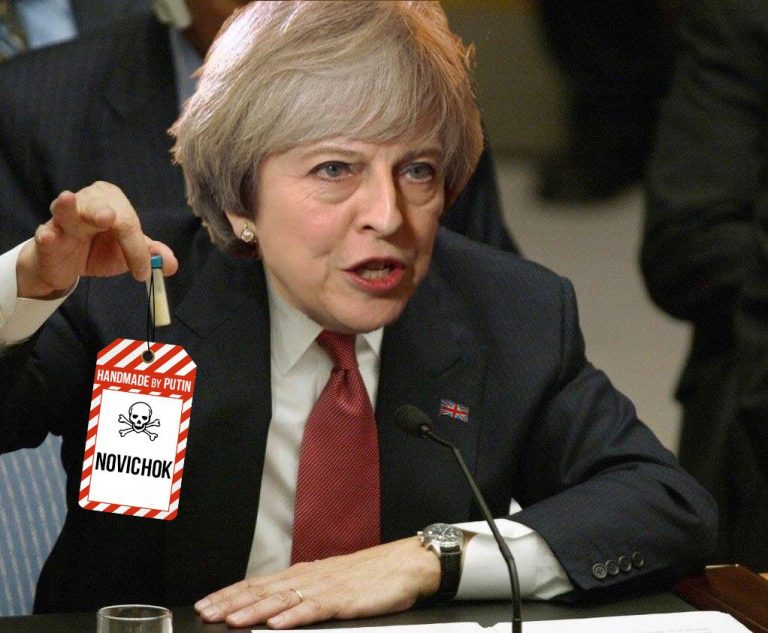
The label added by the montage's author
The picture shows May seated at a table in front of a microphone. She wears a dark jacket, a white shirt and a red tie; one palm rests on the table and the other hand is raised. Beneath her fingers is a rectangular label with a red-and-white striped border. It shows a skull and the word NOVICHOK, and an English inscription added at the top attributes the manual production to Putin.
This is a political photomontage. The added label makes the scene look like the presentation of a finished sample with a convenient manufacturer’s name. The image contains no documentary demonstration of the substance by May. The editor turns a complicated discussion of responsibility into a deliberately blunt physical gesture, as if the origin of the dangerous contents were written directly on the label. The exact base of the collage and its creator are not known, and the effect rests on May’s recognizability and a crudely simplified visual attribution.
Two different meanings of one name
The linguistic layer works without a political portrait. “Novichok” usually means a person who has only just started something and is still learning. In a news context, the word is tied to a dangerous substance and a secret development program. The collision of these meanings makes it possible to build a line so that its first half sounds like an ordinary introduction, while the second half suddenly returns the viewer to the March headlines.
The photo-parody works differently: it makes an invisible and complicated topic visible. A small package replaces an investigation, and the label turns a political accusation into a parody of a product description. The convincing setting of the speech intensifies the deliberately absurd simplicity of the added object. The viewer sees at once the familiar official tone and a conventional prop that appeared at the author’s will. In this version, the joke concerns the way the news is presented and the public figures discussing it.
A pun in invented everyday conversations
In the first invented sketch, a game club announces: “Tournament today for newcomers.” The next line reports that the organizer has spent the last half hour persuading participants not to discuss international news. The humor comes from an unwanted association: a harmless category name suddenly requires a long explanation.
In the second version, a person sorts notes and creates a folder called “Novichok.” The first drawing lessons are supposed to go into it, but automatic news selection fills the folder with political headlines. One label combines incompatible topics, and an attempt to keep a calm study archive turns into an absurd news feed.
The third example is styled as a parody theater program: a beginning actor receives the role of “Novichok,” and an artist draws next to it an overly solemn diplomatic microphone. The ordinary start of an acting career suddenly acquires the trappings of a government statement. The comedy rests on how a familiar word drags a foreign context along with it. These variants show why the news name was able to live apart from the original reports and turn into a short cue for entirely different stories.