Jeroom's original joke
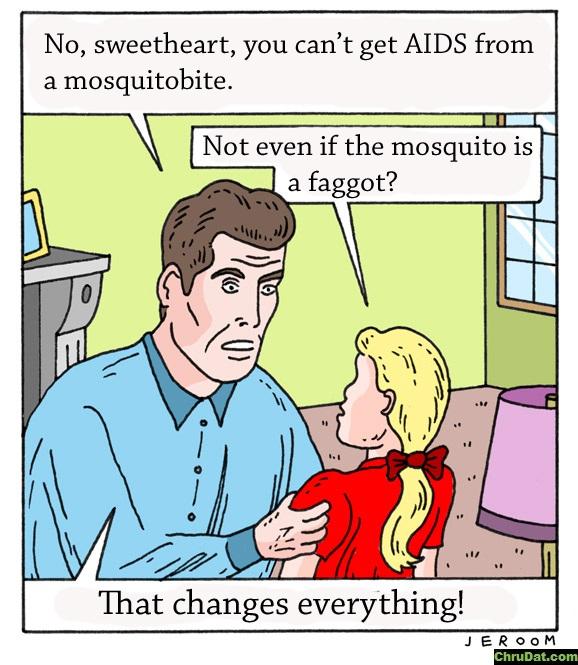
The comic is linked to the work of Belgian caricaturist Jeroom and its publication in Humo in 2011. In the English version shown here, the father explains to his daughter that a mosquito bite does not transmit HIV. The girl adds a question based on a homophobic stereotype, and the adult suddenly declares that this changes things. The punchline is absurd: the trait mentioned has no bearing on how the infection spreads, and transmission through mosquitoes is impossible in the first place.
Later remakes replaced the lines while keeping the serious adult and the child. The well-known Tumblr variants appeared in 2012; the English translation of the original joke spread on Reddit as well. The father might impose a hobby on his daughter, accuse her of some ridiculous misdeed, or demand the impossible. Thus a single satirical line grew into a whole family of dialogues about a person who uses parental confidence in place of reasoned argument.
One drawing, three text voices
The father is shown on the left, in a light blue shirt. He holds his daughter by the shoulder and leans toward her; his expression is tense and serious. The girl in red clothes looks up at him. She has light hair gathered in a ponytail with a red bow. The action is set in a domestic interior with a green wall, a window and a lamp. The artist's signature JEROOM is visible at the bottom.
The drawing consists of a single scene rather than a sequence of movements. The reading order is created by three text blocks: the adult's words at the top, the child's reply next to her face, and the closing line at the bottom. On the chosen image these spots are already occupied by English dialogue. This construction lets the heroes keep their poses when the storyline changes: first the reader gets a confident explanation, then a clarification, after which they expect a reasonable correction, and finally a mistaken conclusion.
The adult proves less reasonable
The main reversal concerns the distribution of roles. Usually the child asks and the adult helps make sense of things. Here the outward form is preserved, but authoritative speech does not guarantee logic. The father may retreat from his own correct statement out of prejudice, or keep insisting after an obvious objection. The child becomes a convenient carrier of a short correction that exposes the failure of the interlocutor's long, confident position.
In the meme variant, the characters may represent not a family but competing tastes, organizations, or one person's habits. For example, the adult speaks on behalf of the desire to control everything, and the child on behalf of a simple circumstance that cannot be undone. The serious gaze and the restraining hand intensify the pressure. The comedy arises when insistence clearly does not match the content: the conversation looks important, while the idea being defended increasingly contradicts what was just said.
New illogical conversations
Invented dialogue: the father demands “Always answer your calls,” the daughter reminds him “You took my phone,” and the ending reads “Don't make excuses with technology.” The problem is created by the one making demands, yet he still assigns the blame to someone else. The final line does not resolve the contradiction; it underlines it.
Second variant: “You need to go to bed earlier” — “You turned on a three-hour movie” — “That's cultural development, it doesn't count.” Here the adult invents an exception for his own choice. Third scenario: “Don't believe everything on the internet” — “But you read it in the comments” — “Those avatars were very convincing.” The child asks a short verifying question, and the father's serious pose turns a comically weak explanation into a display of conviction that outweighs any arguments presented.