A model with two directions
The Political Compass project dates back to 2001. Its core principle is not to reduce all political differences to a single line between left and right. The horizontal scale is meant for economic views, while the vertical scale separately describes social orientation between authoritarianism and libertarianism. A user answers questions and receives a position on a plane. It is this visual test result, rather than a long sequence of questions, that became the basis for numerous pictures.
Early known parodies of the diagram can be traced to internet discussions in 2012. In 2016, variants appeared more often in Imgur collections; a community called Political Compass Memes emerged on Facebook. Characters from The Simpsons, SpongeBob, and other pop-culture figures joined the political statements. In spring 2018 there was another noticeable wave of simplified explanations and remakes. The general structure survived, but its content stopped being limited to the results of political testing.
What is written on the blank template
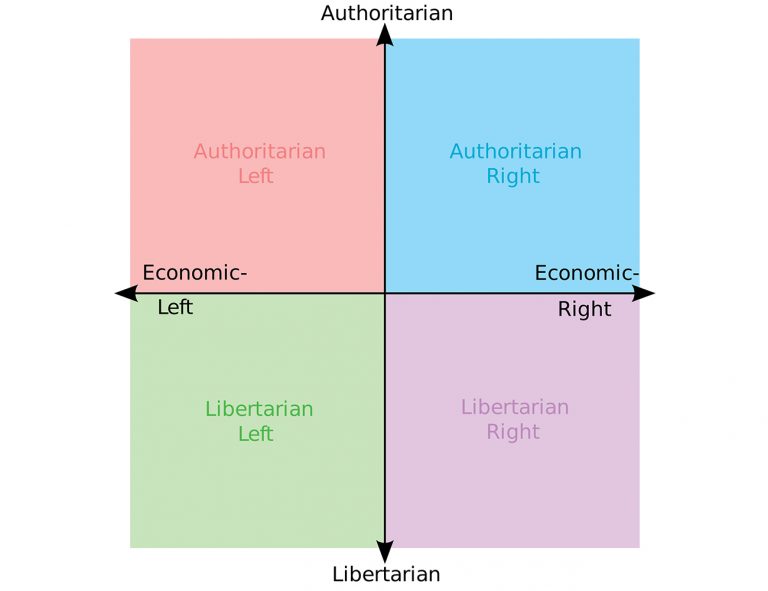
The image shows two black axes with arrows dividing a square into four fields. The upper left is colored pinkish-red, the upper right light blue, the lower left green, and the lower right light purple. Inside are the English names of the quadrants. Horizontally, Economic Left and Economic Right are labeled; vertically, Authoritarian is at the top and Libertarian at the bottom. There are no photos of politicians, test answers, or meme captions here yet.
Four roles within one question
In the political version, each position combines two traits. The top and bottom cannot simply be counted as another name for left and right: their separation is the very reason for the second axis. In meme pictures, authors often reduce these combinations to recognizable stereotypes. One quadrant is assigned a love of strict rules, another a demand for freedom, and then an economic motive is added. The result is a funny argument among four voices, although a real person's views are usually more complex than such a scene.
A parody can fully replace the meaning of the directions. For example, the horizontal axis may distribute attitudes toward order, and the vertical axis the desire to discuss it with others. The quadrants then compare four everyday behaviors. The colored fields and arrows keep the scientific look, which becomes part of the joke: a small habit gets its own grandiose classification. Without these new axes indicated, a viewer might take the captions for political judgments, so their labels help clarify which exact comparison the author came up with.
Why opposites are placed side by side
The format's strength lies in showing several solutions to one problem at once. Instead of a sequential story, the viewer immediately sees four answers and notices the differences between neighboring cells. Extreme positions allow a character to be pushed into caricature, while the center can signal a blend of approaches. However, the placement remains the author's interpretation: the meme does not measure a character's convictions or turn an everyday joke into a reliable poll result. Its argument lies in the chosen examples and how they are juxtaposed.
Invented maps of the kitchen and the hike
In the invented compass of a shared kitchen, the horizontal axis means “cooks strictly by the recipe — improvises,” and the vertical means “sets rules for everyone — only cares about their own plate.” This yields four heroes: the head of the measuring spoons, the leader of the spontaneous soup, the quiet executor of instructions, and the calm experimenter. Each gets a combination of habits, so this is indeed a table with two traits, not four random cooks.
Another invented variant is devoted to tourists. Horizontally stands “saves the budget — loves comforts,” and vertically “plans every stop — chooses on the spot.” The cells hold the compiler of the timetable for cheap buses, the organizer of an expensive route, the seeker of a random campsite, and the spontaneous hotel visitor. The look of a political compass makes the comparison solemn, while recognizable trip details bring it back to everyday scale.