What is visible in the photo
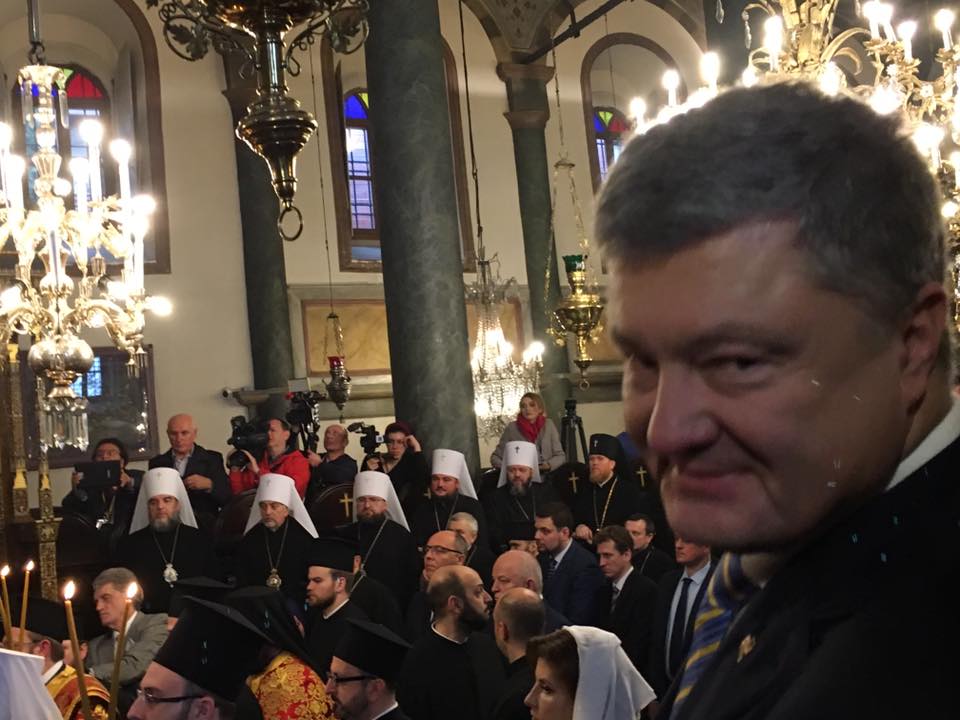
The photo was taken inside a church: chandeliers hang from above, windows with stained glass are visible between the columns, and candles burn at the lower left. In the right foreground, very close to the lens, is a man in a dark suit and striped tie. He glances over his shoulder, looks almost into the camera and smiles slightly, as if he knows something the others don’t.
Behind him stand clergy in dark vestments and white headwear, and further back rows of people in suits and camera operators. The image is somewhat blurred, and the angle resembles a shot taken up close in a crowd. What exactly happened at that moment and what the man in the frame was thinking cannot be said from the photograph.
The event: a tomos for Ukraine
A tomos is a church document of autocephaly, that is, the independence of a local church. In early January 2019, Patriarch Bartholomew of Constantinople handed it to Metropolitan Epiphanius, primate of the Orthodox Church of Ukraine. The ceremonies took place in Istanbul, at the Church of St. George in the Phanar; Ukrainian President Petro Poroshenko attended them.
The signing of the document is dated to January 5, 2019, and the solemn handover of the tomos to January 6. The event was significant for Ukraine's religious and political agenda, so many photographs from it appeared. The meme relies not on the document but on a single accidentally captured frame, where the solemnity of the surroundings and the facial expression in the foreground do not match.
Why the facial expression became the hook
The frame is funny because of the contrast. Around it is a strict setting: chandeliers, vestments, candles. But the man in the foreground turns with a sly half-smile, as if wanting to share a joke. It is a small mystery to which everyone can invent a continuation, so there is plenty of room for captions.
The facial expression lasts a fraction of a second and says nothing about his mood or feelings about the event. The joke concerns the frame, not the biography: it proves nothing about his attitude toward the ceremony or anyone’s thoughts.
Three captions for the template
Examples invented for this frame.
“The ceremony is in its fourth hour, the hall is solemn, and I’m still waiting for the moment it ends.” The stern background and mischievous glance create the feeling that one of the participants is thinking about something else.
“They’re handing out an award, everyone is serious, and I just remembered a joke and can barely hold back a smile.” The solemn setting is close to the presentation itself, and the smile is the relief of someone who already has everything ready.
“The photographer is shooting an official ceremony, and right at this moment I thought about something of my own.” The caption relies on a recognizable situation where a person doesn’t want to pose but still ends up in the frame.
How to use the frame
The frame suits captions about restrained irony, awkward moments, and the mismatch between a solemn occasion and a personal reaction. Short captions that leave room for the viewer to guess work well: the less is said, the more the look does.
Better not to attribute real thoughts or statements to the person in the photo, and not to turn the joke into a political or religious judgment of the event. The meme shows the frame, not a final verdict on the ceremony or its participants.