Two readings of the letters pp
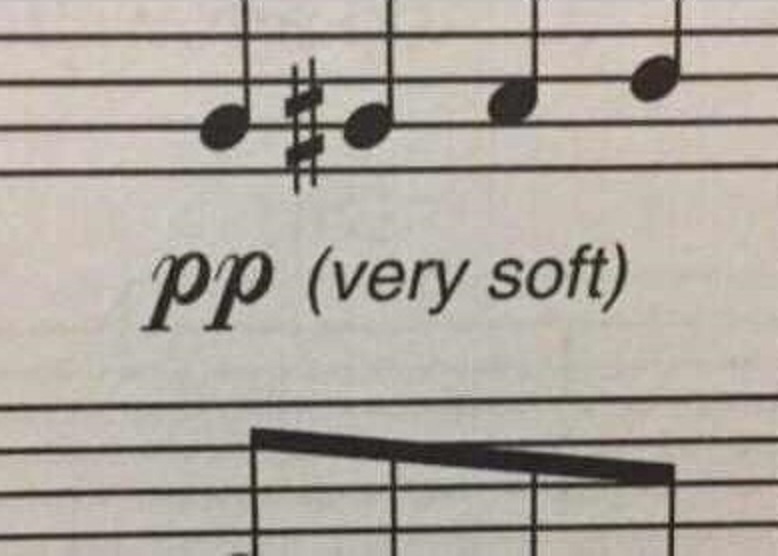
The image shows a fragment of a musical staff, several notes, a sharp sign, and the italic inscription “pp (very soft).” In music, pp is an abbreviation of the Italian pianissimo: play very quietly. Next to it, in parentheses, is the English “very soft,” which is a direct explanation of the same dynamic. The picture itself combines ordinary musical notation and a caption that can be read in another way.
Aloud, the English “pee-pee” sounds like a child’s word for the penis. The letters pp match the abbreviation for pianissimo, and the parenthetical “very soft” simply states that same dynamic in plain English. The joke arises when the eye jumps from a professional term to a colloquial sound; three elements—the abbreviation, the pronunciation, and the parentheses—support the double reading.
From a single picture to a pair
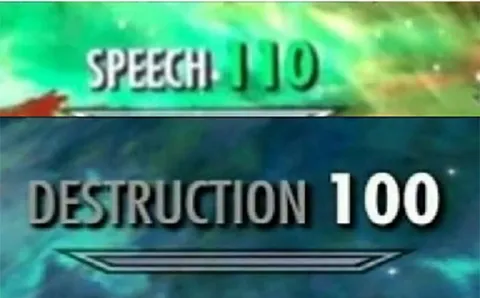
In the fall of 2018, the image was already circulating as a separate pun. Then paired versions appeared: next to “PP (very soft)” people placed “PP (very hard).” The second reading literally sets the soft against the hard, but in musical notation such a pair sounds wrong: a very loud performance is marked ff, fortissimo, not “pp very hard.” The error is what makes the contrast funny.
In the paired macro, one half can show a timid reaction and the other an exaggerated confidence; the captions assign them different situations. In the single version, the leap between the musical term and “pee-pee” is what’s funny. In the pair, this leap is staged as a contest between two reactions: first the deliberately quiet “pp,” then the equally deliberately hard “hard.”
How the musical pun works
The joke depends on the eye reading the letters pp for a split second differently than a musician does: instead of a dynamic marking in notation, it sees a child’s “pee-pee.” The brackets with “very soft” only add to the confusion, because the description fits both musical quietness and the colloquial meaning. A clarification that would settle any doubt about the term in ordinary notation here instead creates a second ambiguity and keeps the pun hanging until the very end of the phrase.
The paired version adds another layer: musically, the opposition should look like pp and ff, but the joke keeps pp next to hard. The mismatch can be heard even without knowing the complex theory: very soft and very hard contradict each other, even though the letter marking stayed the same. Thus the playful violation of musical logic becomes part of the pun, rather than just a caption under the notes.
Invented captions
“They asked me to play more quietly, so I press the keys as carefully as if I were typing a password.” Here the musical meaning meets everyday caution, while the letters “pee-pee” add an indecent second layer. For the paired format, a pair that keeps the musical error of the original works well: “Asked how the report went—pp (very soft): I answer in a whisper; pp (very hard): now I’m retelling it to everyone in the chat.”
Another pair: “Opened my exam results—pp (very soft): quietly staring at the screen; pp (very hard): loudly telling everyone that I studied.” All captions are invented. The single macro better holds the instant pun, while the pair preserves the notational error itself—pp is opposed here not to ff but to hard, exactly as in the original paired macro—and plays out two incompatible responses: quiet and excessively loud.