A small gesture at the finale of a big fight
In the first Kung Fu Panda film, released by DreamWorks in 2008, the panda Po goes from a dreamy kung fu fan to the Dragon Warrior. His opponent is Tai Lung, a dangerous and experienced fighter. The final showdown completes the hero’s story, whose unusual appearance for a long time seemed incompatible with the role of a great master.
One of the most memorable moments of this fight is the finger grab: Po holds Tai Lung’s finger and looks completely calm. Then a small gesture is accompanied by a short line, “Skidysh,” and a powerful golden wave. Instead of yet another long series of blows, the film offers a compact and comically effective finale. In the English version the line sounds like “Skadoosh.”
In February 2018, the scene was spreading on Reddit as a template with captions. Sequences of several frames appeared: the grab, the moment of decision, and the result. The film and the meme wave are about ten years apart. The exact first use of a particular caption has not been established, but the construction quickly separated from the plot about the Dragon Warrior and came to signify all sorts of ways to get rid of an obstacle.
Po has not finished the move yet
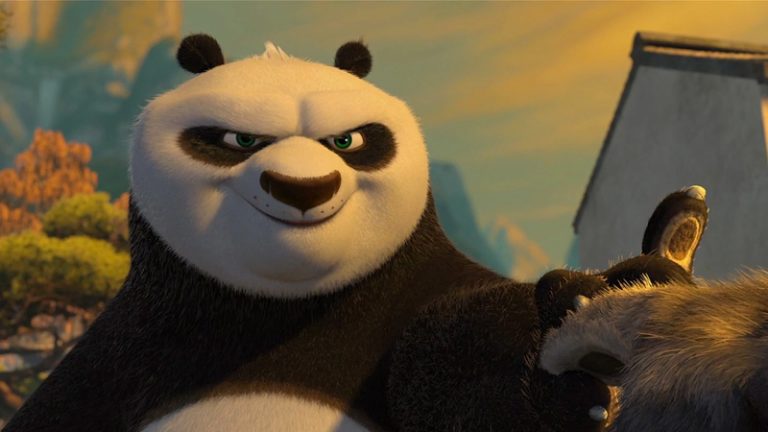
This shows one large frame. Po’s face takes up most of the image: green eyes look at the opponent, and his mouth is stretched in a confident smile. At the bottom right, the finger grip and part of Tai Lung’s paw are visible. Behind the hero is a warm background with a tree and a building, which recalls the film’s setting.
There is no golden wave in the picture yet, and no several panels among which captions could be distributed. So this frame mainly conveys the state before the action: Po already knows what he will do and has no doubt about the result. The sequence of the full move helps one recall it through the facial expression, but the image preserves precisely the pause of anticipation.
Confidence out of proportion to the movement
The main contrast arises between the size of the gesture and the magnitude of its consequence. A finger grab looks almost unserious compared with an ordinary on-screen fight, yet it turns out to be decisive. The meme amplifies this gap by putting a small everyday action in place of a powerful move: closing a tab, flipping a switch, or saying a single phrase.
In the sequential version, the first caption names the irritant, the next one indicates the way to get rid of it, and the final frame shows its exaggerated effect. The viewer only needs to understand the chain of cause and effect. In a single-frame reaction, the result remains outside the picture: the satisfied smile promises that the hero has already found a short answer to a prolonged situation.
Po’s confidence also allows expectations to be flipped. Outwardly he may seem less dangerous than his opponent, yet at the chosen moment he conducts the conversation on his own terms. That is why the frame suits not only overcoming an obstacle but also a person who was underestimated. The joke lies in a suddenly discovered advantage, and the small gesture makes that advantage especially expressive.
Decisions that fit into one movement
In an imagined version, a browser demands attention with a dozen tabs of unfinished purchases. A user whose mood resembles Po’s clicks “close all.” The golden wave in the continuation would mean the disappearance of a huge virtual market. A single click proves stronger than many promises to definitely come back to each item.
Another scene takes place in a kitchen: guests argue for a long time over who gets the last slice of pie. The host calmly cuts it in half. His small movement becomes the decisive move, because it eliminates the very object of the dispute. The comic scale comes from the solemn expressions of the disputants, who a second earlier were expecting a difficult decision.
In the third case, players in a game discuss a riddle and build increasingly complicated theories. The quietest player notices that the hint is printed on the back of the card and turns it over. Po’s smile conveys the pleasure of the discovered shortcut: a long argument is ended by a movement everyone could have made from the start. Each scene uses the difference between great tension and a small action in its own way.