Black Mirror learned to quack
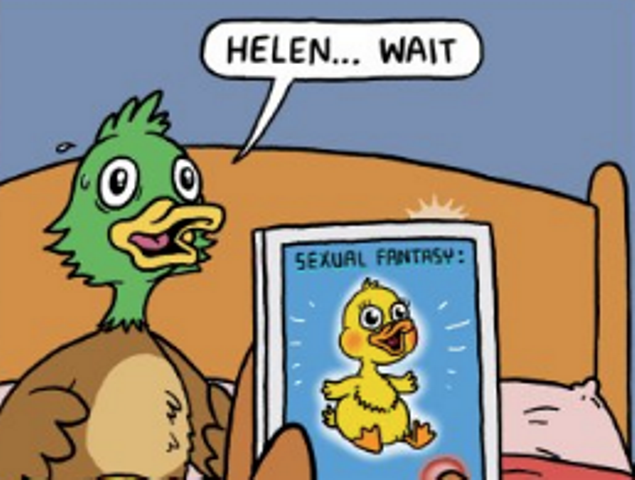
Artist Andy Pandy, author of Pandyland, created the parody series Quack Mirror based on Black Mirror. The title replaces “black” with “quack,” the English word for a duck’s call. The third installment, published in February 2018, depicts ducks trying out an app that supposedly identifies hidden sexual fantasies from a photo. The home check promises a curious result and leads to exposure.
In the original storyline, the tablet shows a duckling, hinting at an inappropriate attraction of an adult character, and in the finale the drake is led away by police. This is a grim fictional story about technology that instantly drags a secret into the open. In early March the comic spread on Reddit, including in the r/blackmirror community. Users began replacing the on-screen image while keeping the character’s reaction and the structure of the sequence.
The tablet stands between the hero and the viewer
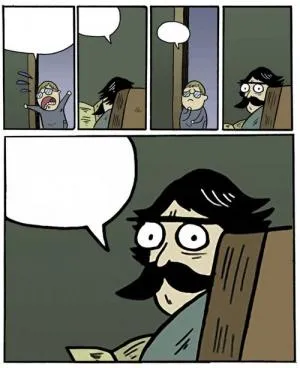
The image shows only a fragment of the comic with the check result. The green-headed drake sits on the bed with rounded eyes and an open beak. Above him is written “HELEN... WAIT,” that is, an address to Helen asking her to wait. In front of him is the tablet with a caption about a sexual fantasy and a picture of a yellow duckling. Another character is only partly visible on the right; there are no police in this panel.
The screen occupies the middle of the scene, so the viewer first sees the result and immediately links it to the fright. The hero has not managed to formulate an explanation: the short request leaves the line cut off. Such a moment is convenient to carry over into a remake. The new content on the tablet provides an unexpected cause, and the ready-made reaction shows that the hero would prefer to avoid detection or at least gain time to answer.
The app controls the right to explain
The parody is recognizable by the logic of Black Mirror: a simple technological capability suddenly changes relationships between people. One participant gets a visible result, and the other becomes its object. The machine seems to tell the final truth faster than a person can tell their own version. The comic montage accepts such a structure of the world as a given and allows only what was discovered to be replaced.
In a domestic remake, along with the picture, the purpose of the check can also be changed: let the program reveal a hidden habit, a preference or a small trick. Then the grim ending becomes a parody of an overly strict attitude toward a harmless secret. The size of the reaction stays the same, but the cause shrinks. The main connecting element is the awkwardness of the hero, who has already seen the result on the screen and is trying to delay someone else’s conclusion.
Three harmless secrets for a new version
For example, in an imagined version the app would recognize nighttime habits and show a spoon next to a jar of jam. The drake, who assured the family that sweets disappear on their own, asks Helen to wait. His fright gets a domestic cause, and the viewer fills in an advance, poorly chosen explanation about the mysterious kitchen dweller.
Another variant would replace the check with detecting real musical tastes. A person publicly argues about complex genres, but the screen reveals their secret love for a short jingle from an old commercial. The mismatch between image and preference makes the interrupted line funny, though the taste itself harms no one.
In a third scene, the program would discover who always reads the last page of a detective novel first. An open book with a bookmark right at the end appears on the tablet. The hero, who had promised to discuss the novel without spoilers, suddenly finds himself under suspicion. All three examples change the object of the check and keep the pause before the excuse — the moment when the small picture has already told more than its frightened owner meant to reveal.