What's in the picture
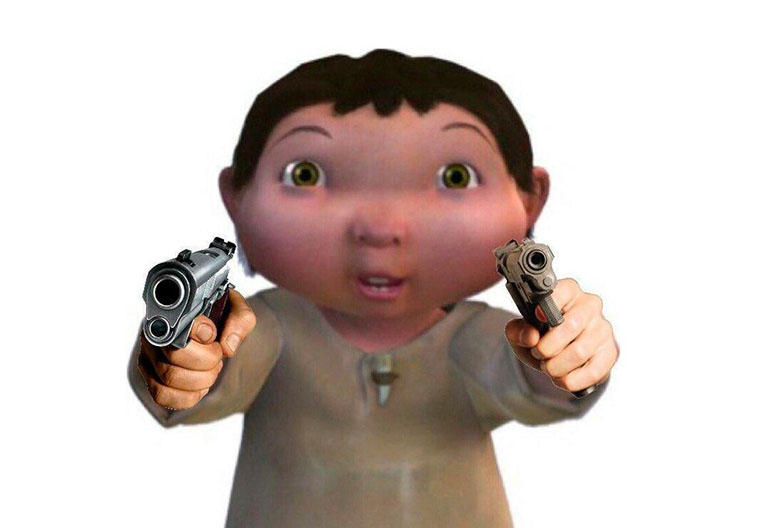
On a white background, in close-up, is a cartoon infant: dark hair, large green-brown eyes, plump rosy cheeks, a slightly open mouth and a light shirt. Real photographs of pistols aimed at the viewer have been inserted into both of his hands. These armed hands are clearly pasted in: the rest of his body has cartoon texture, while the hands look like frames from real life.
The contrast between the innocent look of the baby and the menacing gesture is the basis of the joke. The character looks straight into the camera with childlike surprise, while holding something that is clearly too big for him.
Who Roshan is
Roshan is a human child from the cartoon “Ice Age” (2002). In the plot, the characters find an abandoned baby and try to return him to his father. In the film itself he is a harmless toddler who appears for the sake of the plot and evokes care from the characters.
That is exactly why his status as a meme “villain” is pure play on contrast: the character has not a single real trait that would deserve such a reaction.
How the wave of “hatred” began
According to English-language overviews, it all started in January 2020 with a tweet in the spirit of “retweet if you would beat up the kid from Ice Age,” which quickly gathered tens of thousands of reposts. Soon accounts and pages devoted to mock feuding with the toddler appeared. On February 22, 2020, video blogger PewDiePie released a video on the topic, which gathered millions of views within a few days.
There are no serious reasons for the “hatred,” and that is the essence: millions of views and reposts grew out of a single joking tweet, without a single real accusation against the character. The variations on the storyline are deliberately cartoonish — a fight, a “trial,” a “reckoning” — and none of them lays claim to real violence.
The baby remains the hero of a 2002 film, and nothing threatens him. The format holds up precisely because anyone can substitute their own everyday situation for him: irritation at a harmless trigger instead of the film — at a neighbor, a colleague or an annoying ad.
Examples for your own caption
The baby with pistols is captioned with the resolve of a tired person: “Me when I get a message saying ‘we have a small urgent matter’ on Friday at 18:55” — the meek little face and the weapons depict frayed nerves better than any words.
The theme of exhausted patience also fits: “A polite refusal for the third time in a row” shows the moment when politeness turns into defence.
The frame is also used for jokes about money: “My wallet when I go to the marketplace ‘just to look’” defends personal boundaries in the most comic form.
In all three cases the same mechanism works: the meek look of the infant and the bold gesture with weapons do not match, and this gap makes any everyday cause funny.
How to use the template
The picture is good for lines where you need to exaggerate resolve or show a “polite threat.” It is better not to use it as a threat seriously aimed at a real person: it is a joke about a fictional character.
It is convenient to put the caption at the top, where there is free white space. If you make your own edit, note that the original frame from the cartoon contains no weapons; they were added in drawing.
A good way to check your caption: remove the picture and read the text separately. If even without it the phrase shows an unexpected shift in tone from meekness to resolve, the template will work. If the caption only explains that a child with a weapon is drawn in the picture, there is no joke in it.