What's shown
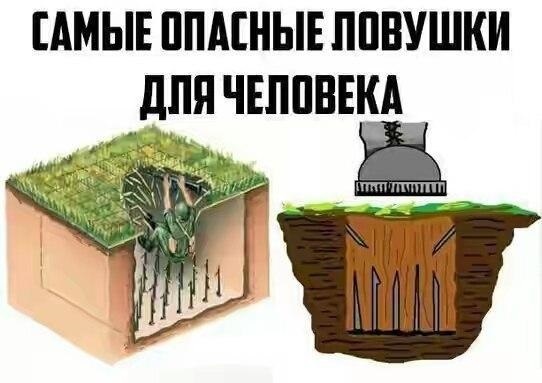
The picture, titled "The most dangerous traps for a person," shows traps that have historically been used in nature and in human history for hunting and defense. In the classic version, three real traps and snares capable of causing serious harm are shown, and a fourth item denotes an everyday or personal annoyance.
In the version that made it into the database, two scenes are visible: on the left, a closed box with a grass-covered lid and sharp stakes inside; on the right, a pit in the ground that a boot is stepping into, with pointed stakes jutting up from the bottom. Both illustrations are drawn in the style of a textbook diagram, which heightens the sense of real danger and makes the contrast with the final item funnier.
The logic of the joke
The meme relies on expectation. The viewer expects a logical ending after a series of deadly traps, and instead gets an unexpected, everyday item. This device has long been used in humor: a buildup of seriousness followed by an abrupt pivot to something trivial creates a comic effect.
The caption "The most dangerous traps" in the English-language version and its Russian translation heighten the irony, since they cast a serious tone into an ordinary list of dangers. The meme itself can be adapted to any everyday nuisance that seems minor but, in a given moment, feels worse than any real threat.
The picture's strength is that it requires no knowledge of specific traps. The viewer recognizes the familiar genre of textbook illustration, understands that this is about deadly danger, and only at the end runs into the mundane punchline. This structure transfers to any topic, from commuting to work to buying furniture, as long as the caption is chosen precisely.
Origin and spread
The exact author and the first publication of this picture are not known. It's known that in 2017 images like this spread widely across social networks and forums, but the specific original source is unknown.
The picture was reproduced as compilations and reworkings: authors swapped out the illustrations, added their own variants, and kept the overall structure. This approach is typical of template-based memes, which are easy to adapt and reproduce.
Variants and usage
The meme is used when someone wants to joke about something minor but unpleasant: for example, stepping on a forgotten toy, losing a pen, or a long wait in line. The phrase "the most dangerous trap" sounds like a dark joke and turns an everyday problem into something funny.
Sometimes the picture is used in response to dramatic statements: a conversation partner describes a serious risk, and the other person replies that the real threat is something trivial, like a dropped phone.
There's also a subtler use: the picture is used to express sarcasm about other people's fears. When someone is worried about an unlikely danger, sending this picture is enough to remind them of the real scale of problems while also poking fun at oneself.
Why the picture works
The joke rests on simple graphics and short text. A title, two drawings, and a clear contrast let the humor land within seconds, which makes the meme easy to forward and comment on.
Another strength is its universality: the traps are understandable without translation, and the everyday annoyance is familiar to almost everyone, so the picture is equally funny across different countries and settings.