A vocabulary that grew out of hints
In the summer of 2024, Russian-language short videos started breaking down several neologisms, often grouped together in lists. Some of the words were used as euphemisms or a way around restrictions on directly offensive language. The meaning could depend on the community and the specific video, so the list shouldn't be treated as a universally accepted glossary with fixed definitions.
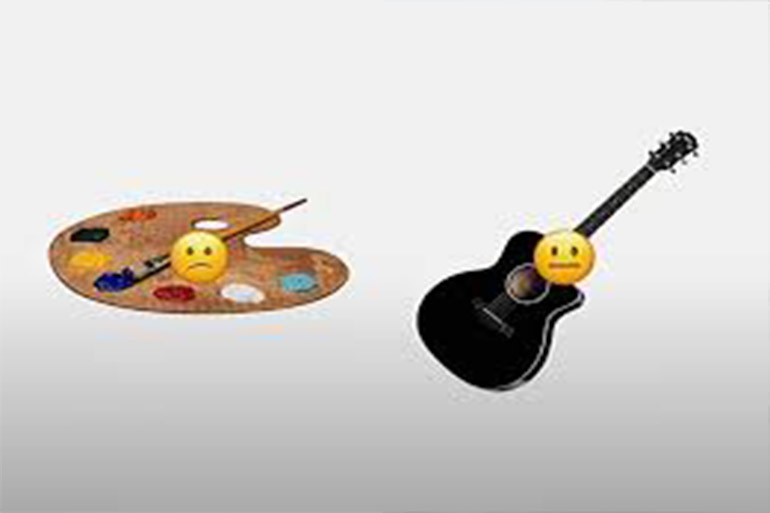
The image shows an artist's palette and a guitar, with the same displeased face placed over each object. This pairing doesn't explain the contested vocabulary so much as it points to a pair of words that sound alike. No sexual or demeaning decodings are reproduced here: for understanding the meme itself, the substitution mechanism matters more than the details of the potentially offensive terms.
Why neutral words become a code
Ordinary objects and plants seem harmless on their own. When they're placed in the same list with unexpected parallels, an in-group jargon effect appears: insiders pick up on the reference, while everyone else just sees a strange table. Sometimes this is a game with censorship, sometimes a way to sound absurd and deliberately overload a conversation with a pseudo-dictionary.
The picture with the palette and guitar works through visual category and sound-alike similarity. It's not an instruction to interpret both words the same way in every situation. In wider use, the set itself could become an object of parody: people repeated the list to show how quickly any neutral word can pick up a dubious hidden meaning.
Two replies without a dictionary to translate them
"Someone sent me a picture: the palette and the guitar have the same displeased face, and there's no caption. I didn't get the joke, but just in case I made a displeased face too." What's funny here is simply the feeling that some code known only to a few is hidden behind a pair of neutral objects.
"Someone sent me a palette and a guitar and asked which one to pick for Friday night. I brought brushes and chords." The reply deliberately returns the words to their literal objects. The contrast between the expected slang reading and the plain literal choice gives it an innocent twist, without reinforcing any offensive label.
Context matters more than the decoding
This kind of template suits conversations about fast-changing internet slang, euphemisms, and how platforms shape users' language. It can be used in a linguistic or media discussion as long as it's clear the meanings are local. For a light joke, it's enough to show confusion in front of a strange list.
Don't aim coded words at a specific person, especially when they're used to judge someone's body, orientation, or identity. The meaning of the term can vary, and a hidden form doesn't make the insult harmless. In this particular picture, only two objects and their drawn reactions are clear; everything else requires outside context rather than a guess based on one emoji.
How to read a list like this
The list is funny partly because it's incomplete: the reader sees several familiar words but never gets the overall dictionary that would explain them once and for all. In one video it might be a reference to a specific group, in another a parody of the very fashion for coding speech. So a random decoding shouldn't be applied to just any author, or treated as an accepted meaning. The picture has a clear literal level — a palette and a guitar; the meaning of the second level depends on context that a single image may not provide.