Replacing a missing lock
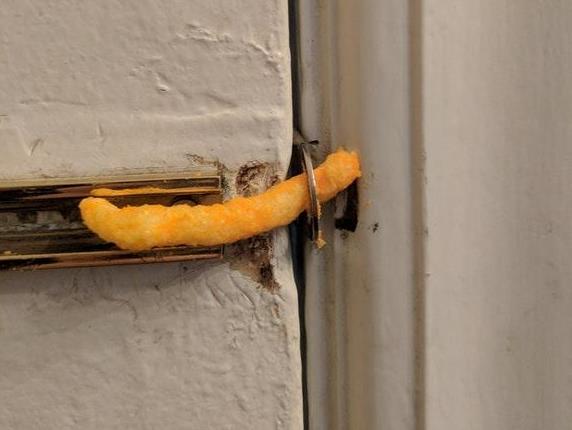
On May 20, 2018, Reddit user kt000545 posted a photo to the r/DiWHY community. The caption explained that his friends had lost the lock for their bathroom. Instead of the usual fastening part in the guide rail, there lay a Cheetos stick. The replacement looked both resourceful and pointless: the object filled the required spot, but its material did not match the task at all. The name of the photo's author, separate from the user who posted it, has not been reliably established.
In early June, the photo picked up new captions. On June 1, Twitter user MalwareJake used it for a joke about storing administrative data in HTML comments. The door latch thus became an image of questionable protection for a digital system. Then variants appeared about weak personal bans and indecisive refusals. The original bathroom situation gradually faded into the background: viewers were content with the most fragile object standing in for a reliable barrier.
The bolt kept its shape and lost its strength
The photo shows a close-up of the joint between the door and the adjacent part of the structure. On the left is the old metal guide rail; on the right, the fastener into which the end of the orange stick passes. The white surface shows scuffs and chipped paint. The image itself carries no captions. The entire visual story fits in one place: the element that is supposed to hold the door is made from a snack.
The snack resembles a bolt in its elongated shape, and it is this surface resemblance that makes the substitution funny. It sits where the viewer expects metal, so the device at first glance keeps the familiar order of parts. On closer look, it becomes clear the resemblance extends only to shape. In the frame no one opens the door or tests the lock; the comic judgment arises from the recognizable material, not from any shown successful break-in.
The appearance of a restriction instead of a restriction
The meme often describes measures meant to make an impression rather than to resist. The door stands for what a person wants to protect or fence off, and the stick is the only barrier. The result is a nominal ban: it exists only until someone seriously tries to pass. This easily transfers to a single short rule, a setting left unchecked, or a habit to which someone has opposed a pretty but weak promise.
In another reading, the decision's author is the joke. He seemingly found a replacement for the missing part but was satisfied with minimal outward resemblance. The picture then expresses haste: the main thing is to announce that the problem is solved, and the question of quality is postponed. The colored snack against the old door underlines the temporary nature of such a repair. So the joke can be about insufficient protection and also about the convenient self-persuasion that it is enough to put something in place of the bolt.
Invented ways to close the door
First invented example: the door reads “an evening without work messages,” the stick reads “sound off, as long as I keep checking notifications anyway.” The restriction is formally in place, but the habit keeps passing through it. In a second invented variant, the fastener says “family pie recipe,” and the snack carries a note “do not show anyone,” lying next to the ingredients. The comic protection exists only because everyone is expected to observe it voluntarily.
Third invented caption: “My savings on delivery” is the door; “no ordering until the first rain” is the stick. The barrier is calibrated exactly until the first setback, after which the hero is ready to abandon it. Such examples do not require adding a second picture of a broken door. The weakness of the solution is visible in advance, and the viewer imagines the next step on their own. It is precisely the predictability of the concession that turns a small object into a handy image of fragile restriction.