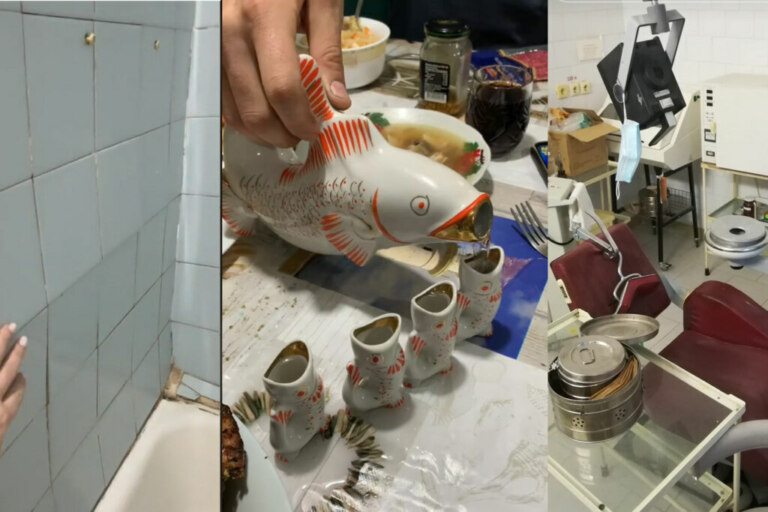
Three scenes instead of a museum exhibit
The image shows three vertical panels. On the left are a tiled wall and part of a room; in the center a hand holds a bright object that looks like a toy or homemade item above a row of small containers; on the right is a cluttered space with pipes, furniture, and plumbing fixtures. The collage joins dissimilar fragments rather than showing one specific factory-made item with a certificate and production date. It is impossible to establish from this image alone that all three scenes belong to Soviet everyday life.
That is exactly why it's useful to separate the template itself from any historical claim. The meme format can poke fun at nostalgia, but the picture is not proof of the quality of all Soviet-made goods or of any particular item's origin.
How the phrase "they don't make them like that anymore" appeared
In the fall of 2024, a TikTok sound spread featuring the solemn repetition "Soviet quality! They don't make them like that anymore" along with similar approving lines. Posts from that period described clips featuring worn furniture, plumbing, appliances, and other items, where the praise played out against their dubious appearance. This produced a simple comic formula: the more confidently the admiration sounds, the more noticeable the mismatch with what's shown.
In some posts the sound is credited to Roman Vintoniak, and reviews point to an early TikTok post by this author in September 2024. Neither the original post itself nor an earlier source for the audio has been independently confirmed. So it's fair to speak of a noticeable wave of the trend in the fall of 2024, but one should not treat a single author of the phrase, or the very first clip, as an established fact.
Irony isn't the same as judging an entire era
In the typical version, the shot shows a worn item, a crooked repair, or an awkward design, while the sound praises it as a model of quality. The comedy comes from the literal collision of two messages. The viewer understands the voice sounds exaggeratedly enthusiastic, and decides for themselves how well the object matches the praise.
This is not a historical assessment of materials or defect statistics. Soviet products varied by industry, model, storage conditions, and length of use; the meme selection picks the most striking examples and doesn't allow conclusions about an entire industry. In some clips the joke targets the cult of the phrase "things used to be better," while in others people are genuinely nostalgic or defending durable goods. The context of a specific video matters more than a single label.
Captions for a collage of different objects
A collage like this gets captioned with lines like: "Soviet quality: the engineers added one more adapter, then another — at an angle" — for a busy right-hand panel where the eye catches on countless details; "Soviet quality: the repair holds up as long as the cabinet doesn't move" — for a room shot with a habit of hiding an awkward fix; "Soviet quality: it didn't turn on — that just means it needs some character" — the solemn praise becomes a parody excuse for baffling equipment.
All three phrases work the same way: the performative enthusiasm in the sound passes off an ordinary household flaw as a signature trait of a bygone era, and the more serious the praise sounds, the more absurd the adapter, the cabinet, or the uncooperative appliance looks.
How to use the audio and the picture
The template is especially clear when the praising phrase plays over visible unevenness, wear, or unexpected complexity. You can show your own item, something you genuinely have a story about, or create a fully staged scene and emphasize that it's staged. Don't declare a random image an "authentic Soviet product" without information about its origin. If you genuinely like the object, the meme can be good-natured nostalgia; if the mismatch is deliberately emphasized, it's sarcasm.