Campaign poster turned inside out
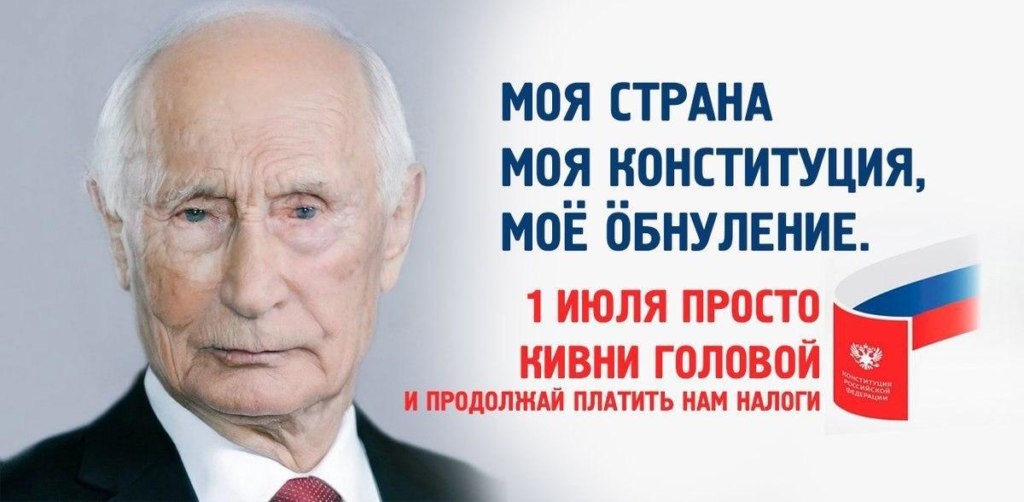
On the left is a large portrait of an elderly man: sparse gray hair, deep wrinkles, an attentive gaze, a dark jacket, a white shirt and a red tie. The face is clearly edited: the age is exaggerated as if the figure were decades older. The background is light gray, like official portraits, so the portrait looks stern and solemn.
On the right, in large blue and red letters: “My country, my Constitution, my term reset. On July 1, just nod your head and keep paying us taxes.” Beside it is a red booklet with a coat of arms and a caption about the Constitution of the Russian Federation, wrapped in a ribbon in the colors of the Russian flag. The font, colors and composition copy the style of campaigns that urged people to go vote, while the meaning of the text turns them upside down.
Events of 2020
On March 10, 2020, Duma deputy Valentina Tereshkova proposed an amendment that would allow the number of terms already served by the sitting president to be reset to zero. That very word became the centerpiece of the discussion around the amendments. The nationwide vote ran from June 25 to July 1, 2020, and July 1 became the single voting day referenced on the poster.
According to official data, most participants voted in favor of the amendments: about 78 percent, with turnout of roughly 68 percent. Assessments of the vote itself differed in society and in the press, so it is accurate to say that the poster expresses the position of skeptics rather than an established fact about how everything happened.
Why “Just Nod Your Head” works
The core of the joke is the shift in tone. Posters usually address the citizen in the language of “your choice matters.” Here the language is official, but the meaning is cynical: you are asked not to think but to nod, and to keep paying taxes on top of it. It is a parody of the idea that your vote decides nothing, and every viewer reads it at the level of intonation.
The image itself adds another layer. The deliberately aged face can be read as a hint at conversations about how long a person has held power. The device is simple but effective: the picture needs no long explanation, because everything necessary lies on the surface. At the same time, this is satire, meaning an expression of the author's opinion, and it should be read as an evaluation rather than as a document.
Captions that would fit
The topic is political, so the examples below are built on neutral situations to show the mechanics.
“My apartment, my renovation. On Saturday just nod your head and keep carrying tiles for me.” A domestic version, where the ironic appeal is aimed at a close person.
“My party, my music. At midnight just nod your head and keep singing along.” This caption uses the same structure: a solemn opening and a casual ending.
“Thanks for voting for the constitutional amendments package: now you can forget about them.” The thank-you phrase sets the tone, and the second half undercuts the seriousness.
How to use the template
The caption structure consists of a solemn slogan and a simple, almost down-to-earth ending. Try to keep the official font and the two colors: blue and red. If you change the text for a different occasion, don't break the rhythm: three short slogans and one explanation.
Since the poster depicts a public figure and the face has been altered, do not present the picture as genuine campaigning and do not use it as evidence of any events. Jokes about real people are best built around public decisions rather than appearance, health or private life, and satire should always be kept separate from facts.