The big brain as transport
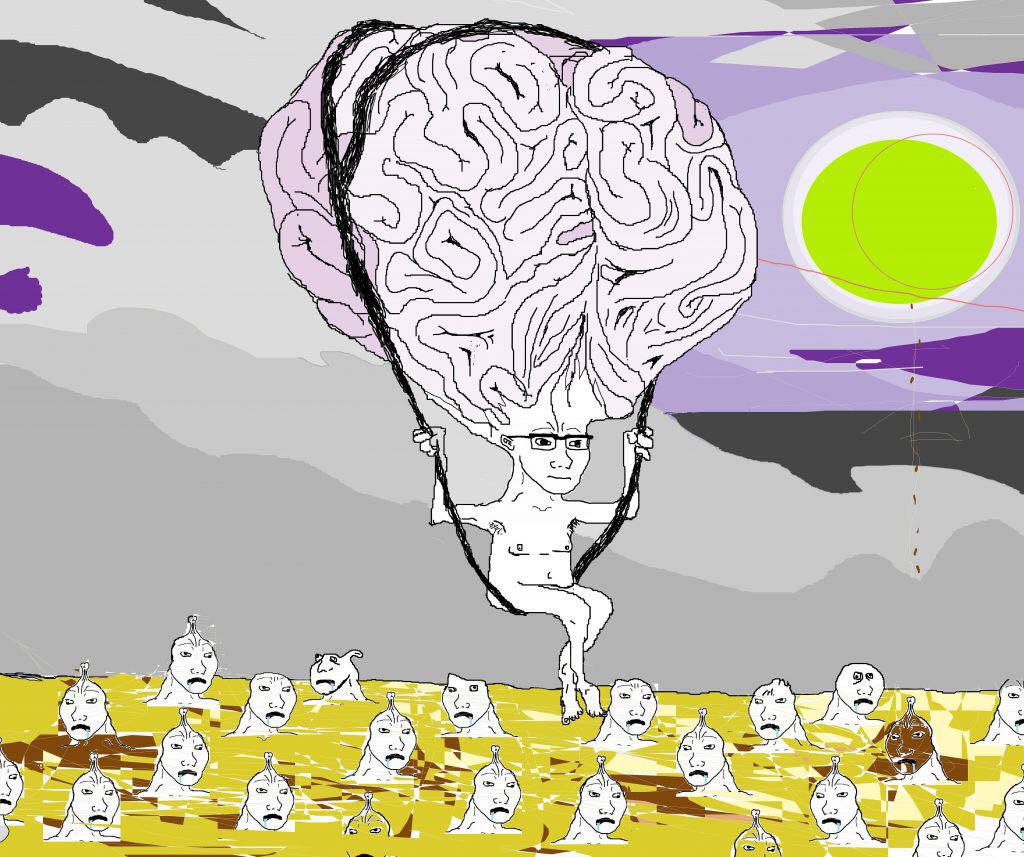
In the local drawing, a person holds the straps of a giant brain and flies above a crowd of small-headed figures. Below, they stand in yellow water and look up at the hovering hero. This is not a step-by-step chart with several versions of one character: a single comparison has been chosen here — one person rises above the others thanks to an enlarged brain. The exaggeration becomes concrete. Ability is not merely indicated by a big head; it literally lifts its owner above the environment. That is why the image can mock both genuine erudition and a person who thinks he is a genius simply because he talks in more complicated terms than those around him.
Connection to the Brainlet family
The drawing descends from the internet series Brainlet, in which the simple Wojak figure was redrawn with an almost empty head or, on the contrary, a disproportionately developed one. Such characters became visible on imageboards in 2017; the brain-balloon version is just one visual joke within this line. In Russian-language posts by August 2018, this drawing already functioned as an independent comparison template. The mechanism itself has survived in separate captions: an exaggerated body becomes a visible equivalent of exaggerated self-esteem.
Impressive scale and self-irony
In the drawing, the unexpected means of transport is the brain itself: it is held up by straps, and the figure beneath it resembles a passenger of a hot-air balloon. Not only the head is enlarged but the whole distance to the others as well. The caption can call the hero a resourceful person who spotted a shortcut, or turn the image into a parody of pompous self-importance. An ordinary thought gets a huge visual carrier — and it is this disproportion that makes such praise funny. The small heads below make it possible to assign roles: they may be debaters left without an answer, or participants for whom the decision seemed too complicated. In both cases the huge brain depicts the joke’s assessment of the character, not a real measure of his intelligence.
Invented comparisons
First invented example: in a chat everyone is searching for where to turn on subtitles, and one person opens the accessibility settings and immediately finds the right toggle. The enormous brain here emphasizes a useful shortcut. In a second variant, a colleague explains a simple table as a “multi-factor row redistribution model,” though he has only sorted a column; the same figure turns profundity into self-parody. The third case: a person notices that the whole queue at a coffee shop is standing at a closed register while another one is working nearby. His flight over the crowd signifies not innate superiority but a lucky observation at a specific moment. All three examples are invented and show different readings of one picture: knowledge, pretentious complexity, and simple attentiveness.