The whistling nobody needed
The scene appears in the episode “Whistling” of the animated series “Peppa Pig,” which aired in 2010. Peppa is trying to learn to whistle and calls her friend Suzy Sheep. At first the conversation promises comfort: her friend can't do it either, or hasn't tried yet. But Suzy immediately tries and successfully whistles. Instead of discussing the difficulty together, Peppa gets a demonstration that her own problem is not a problem at all for someone else.
The response is a silent hang-up. Peppa makes no threats and does not explain her hurt, so the gesture stands out especially well from the children's plot. It can be read as envy, irritation, or a refusal to continue an unpleasant conversation. The comic character of this reaction comes from the disproportion: a small success for a friend becomes a sufficient reason to cut the connection instantly.
A button instead of slamming the receiver
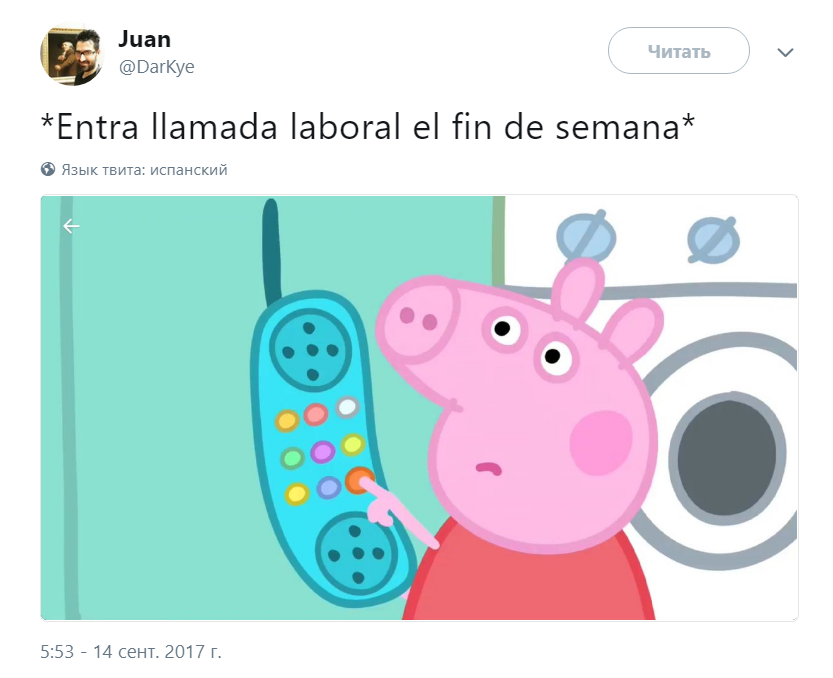
The image shows a single frame, a screenshot of a post by Juan under the name @DarKye. Peppa holds a blue telephone handset with multicolored buttons and presses the orange button at the bottom. A washing machine is visible behind her. There is no sheep beside her: the second participant in the conversation stays outside the frame, and attention is focused on Peppa's face and finger.
The Spanish caption describes a work call coming in on the weekend. This is a fundamental change of role: here the caller is not bragging about whistling, but intruding on free time. The screenshot shows the date September 14, 2017. It refers to a specific post and shows that this phone reaction was being used before the large English-language wave of the following year.
Why the story survived several waves
The clip was spreading on YouTube already in the first half of the 2010s. In 2015, Two Beardy Dorks made an edit of it in the style of Thug Life, giving a childish act a comically defiant character. In March 2018 the scene became noticeable again on Twitter, where the frame began to be captioned with the lines of unpleasant interlocutors and situations after which one wants to end the conversation immediately.
The phone gives the joke ready-made punctuation. The top caption says what the person has heard; the press of a button ends the sentence in place of a spoken reply. The calm manner of a children's cartoon is preserved even when the caption refers to adult work or relationships. This gap between a simple picture and a recognizable irritation makes it possible to do without a long explanation of the emotion.
Three conversations that end the same way
For example, a person spends a week solving a puzzle and calls a friend to share the latest difficulty. The friend replies: “Oh, I just opened it and already finished it.” Peppa becomes the reaction of the storyteller, who was looking for sympathy and got yet another accidental champion instead. Here the new scene repeats the original mechanism of someone else's unexpectedly easy success.
Another caption might start with a call about a free trial lesson. After a brief greeting, it turns out that first you have to listen to twenty minutes of advertising. Peppa's finger cuts off the rest of a sentence that hasn't been spoken yet; what is funny is the speed of the decision, not the content of the lesson being offered.
In the third version, a friend promises to discuss a favorite album but first suggests listening to it at double speed to finish sooner. Peppa expresses exaggerated musical outrage. In all three cases the character speaks for the author of the caption, and her original resentment over the whistling turns into a short silent line: the conversation will not continue.