The cartoon and its characters
Smeshariki is a Russian animated series about a close-knit group of anthropomorphic animals living in a village, which gave the show its name. It premiered in 2005, and over the years it became one of the country's most recognizable children's projects. Among the main characters are the rabbit Krosh, the hedgehog Yozhik, the piglet Nyusha, the ram Barash, the bear Kopatych, and the elk Losyash, each with their own personality and manner.
It's the characters' personalities that became the basis for the meme format. Each character carries a recognizable emotion: Krosh's naivety, Kopatych's grumbling, Losyash's pensiveness, or Yozhik's stubbornness. So a still of any of them reads instantly for the viewer with no further explanation needed, even with a short, ironic caption.
How the format emerged
The exact author of the first Smeshariki meme is unknown. Based on observations found across descriptions from themed communities of that period, the peak of popularity fell in the summer months of 2017, when users began mass-cropping stills from episodes and captioning them. The caption usually consisted of one or two words and translated the scene into a familiar situation.
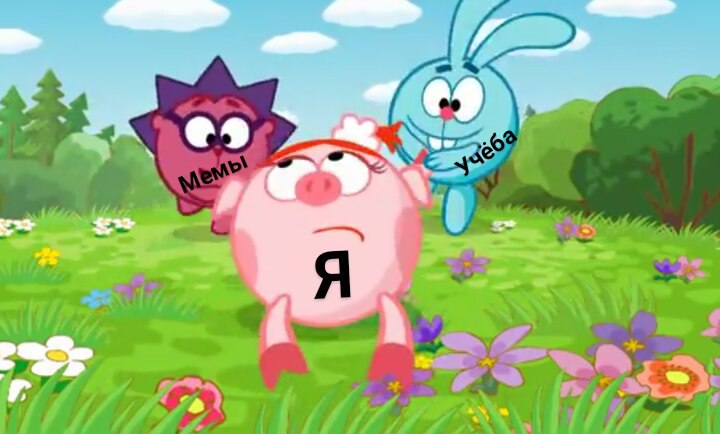
A typical example is a picture in which Nyusha stands in the center with a baffled expression, Yozhik is labeled "memes," and Krosh is labeled "studying." The joke is simple: a person wants to look at memes and study at the same time, and the choice between them is obvious from the characters' poses. This setup let the meaning come together from three stills without a single long piece of text.
The episode-title compilation
A separate branch became stills featuring episode titles. Many Smeshariki episodes have short, everyday-sounding titles, so users started matching them to real-life situations: from an exam and missing the bus to a talk with a boss. The way the title coincided with a real event is what made the compilation funny.
It's important that the format doesn't require knowing the plot. It's enough to know the episode title and understand what the caption is about. That's why the compilations traveled easily into comments, photos, and chats, and over time formed a genre of their own that people kept building and adding to.
Spread and variations
Smeshariki memes spread mainly through social networks and humor communities, chiefly VKontakte and Pikabu. The pictures were reposted, remade, and given new captions, and some authors put together whole series. The format adapted easily to any topic: studying, work, relationships, sports, or a trip to the store.
There are also more elaborate variations, in which the stills serve as a contrast to serious text or, conversely, accompany an everyday story with an ironic illustration. These variations show that the joke doesn't rest on a specific episode but on how recognizable the characters are and on the contrast between a children's storyline and an adult experience.
Cultural context
Nostalgia plays a noticeable role here. For the generation that watched Smeshariki as children, the familiar characters trigger a warm response, and the meme format adds irony on top. The user expresses their own emotions through the cartoon's characters while keeping a light tone and avoiding harsh wording.
Similar techniques have been used with other cartoons, but Smeshariki turned out to be especially convenient because of the large cast of characters and the range of emotions they can express. That's why the format outlived its 2017 peak and remained one of the recognizable templates of the Russian internet.