What is in the picture
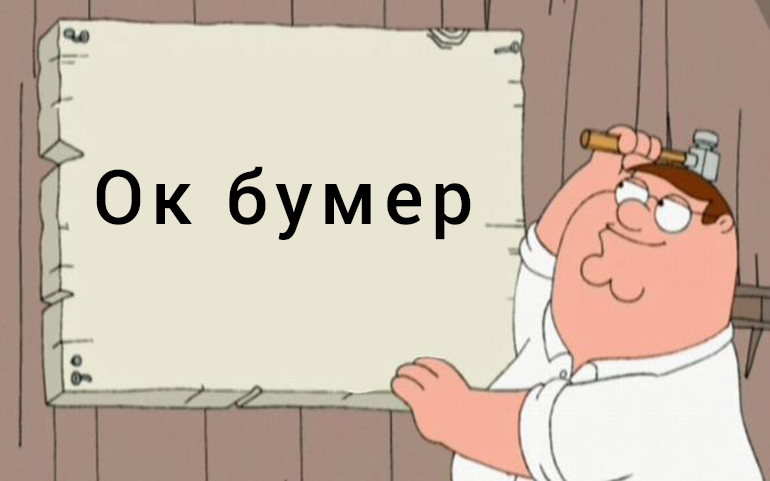
The frame is taken from the animated series “Family Guy”: Peter Griffin, with a hammer in hand, nails a large sheet of paper like a notice to a wooden wall. His face is focused and pleased, and he has slightly bitten his tongue. The background is gray-brown fence boards, and the sheet itself has “OK boomer” written on it in large letters.
The template itself — “Peter nails up a sign” — is used for any announcements and statements. Any text can be written on it; here it carries the phrase about boomers, which turns it into a solemn proclamation.
Where the phrase comes from
The word “boomer” comes from “baby boomers,” the name for the generation born after the Second World War, roughly from 1946 to 1964. Gradually the term came to be applied to older people who, in the opinion of their interlocutors, do not understand the young or stubbornly cling to the familiar.
The expression “OK boomer” is known from isolated mentions as far back as 2015–2018, but it became mass-popular in 2019, largely thanks to TikTok. On November 4, 2019, New Zealand Member of Parliament Chlöe Swarbrick answered a heckler in this way during a speech about climate, and the story spread around the world.
What the phrase means
“OK, boomer” is a polite-sounding but dismissive remark in substance. It means “I heard you, but I won't continue the argument.” It is often said in reply to phrases like “things were better before” or “young people can't do anything.”
It is important to remember that the word “boomer” can sound offensive, because it judges people by their age. In the memes themselves it often refers not to a specific age but to a manner of speaking: lecturing, stubborn, closed to the new. That is why jokes are better aimed at a situation rather than at a person.
The picture with the sign is especially suitable for situations when an interlocutor starts a long speech about how it used to be better. Instead of arguing, it is enough to send the frame, and the remark is solemnly fixed to the wall.
Funny as it is, Peter himself here plays the role of a man who announces a conclusion publicly and takes pride in it. This pose turns a short phrase into an official statement.
Examples for your own caption
“Back then you could buy a house for that kind of money” — “OK boomer.” The reply cuts off a drawn-out nostalgia.
“Don't sit on your phone, you should be reading books” — “OK boomer.” The joke is that the answer is soft while the meaning is harsh.
“But in our time there were no apps at all” — “OK boomer.” It closes the conversation in one line.
“I'm twenty-five and I'm already grumbling about new memes” — “OK boomer.” Self-irony: the author calls himself a boomer.
How to use it
The template works well for short captions where you want to show that you have taken the remark on board but will not argue. It is better not to use it in real disputes with loved ones: the phrase is perceived as brushing someone off.
The most successful jokes with this picture are self-ironic or about abstract “boomers.” Then the meme stays funny rather than offensive.
A variant also works in which the author of the caption hammers the sign up himself, announcing his own habit. Such a move softens the phrase and removes the note of reproach aimed at the interlocutor.