From an art-world Madonna to a symbol
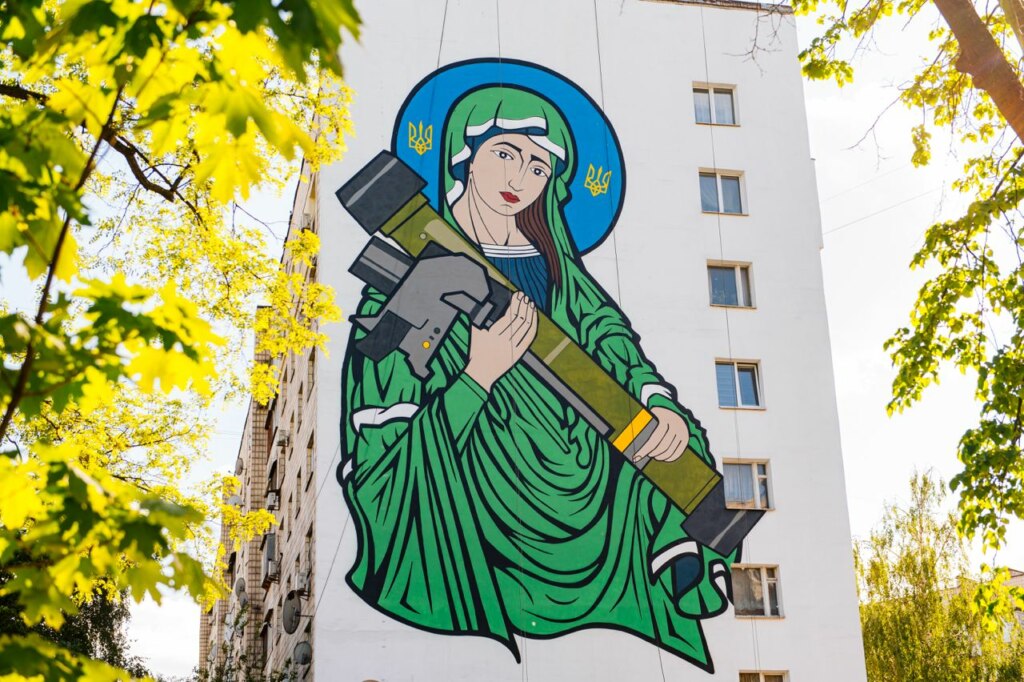
The image draws on an earlier work by American artist Chris Shaw, "Madonna Kalashnikov," in which the Mother of God holds an assault rifle. In 2022, designer Yevhenii Shalashov adapted the composition: instead of an assault rifle, the Madonna holds a Javelin, and elements of a traditional icon layout appear around her. This is a digital image, not an ancient church icon.
The name Saint Javelin became tied to an online store and a charitable initiative that started in February 2022. After the full-scale invasion on February 24, the project began raising funds to help Ukraine. It's important to distinguish between the artistic symbol, the specific campaign, and the actual use of the weapon: these are related but not identical things.
What the combination of images conveys
A holy figure with modern weaponry combines religious and military symbolism. For supporters of Ukraine, it became an image of defense and resilience; in its charity version it appeared on stickers, flags, and clothing. This reading is tied to a specific period of the war, not just to visual novelty.
The local image shows a woman in a green mantle with an anti-tank weapon against a backdrop of Ukrainian colors. This is a stylized poster. The image doesn't prove the combat use of the weapon system in any specific operation and doesn't report the outcome of any particular episode. Its meaning is symbolic, not journalistic.
Captions that respect the context
In a meme adaptation, it's possible to talk about symbols and public reaction without turning a real war into decorative props or attaching a casual joke to it. For example, a caption might point to the combination of images itself: "An icon and an anti-tank weapon system — a pairing that's hard to forget." Such a line works as a comment on the visual choice, not as a joke about combat operations.
Another option is an informational caption for a discussion of visual art: "An old religious composition takes on a new sign of the times." It helps open a conversation about how artistic imagery changes during a crisis period. Invented lines like these aren't the artist's own slogans and don't substitute for a description of the charitable initiative.
Don't confuse iconography with the chronicle of events
The image is suited to discussing contemporary poster art, charitable symbolism, and how the internet speeds up the spread of visual signs. If a post concerns fundraising, separately note the organizer's verified address: the meme itself doesn't guarantee that any product or collection is linked to the original initiative.
Don't call the digital adaptation a traditional holy object, and don't attribute unconfirmed intentions to the artist. Combining a religious image with a weapon can be read in different ways. A respectful treatment acknowledges both the symbolic power of the work and the fact that an armed conflict and real losses lie behind its popularity.
A caption for such an image can speak of resilience, mutual aid, or hope, without appropriating someone else's experience. For instance, in a non-war everyday context: "May this week bring calm news and the strength to support those close to you." If the material is used in a discussion of the war, it's important not to erase its original symbolism or turn real danger into decorative background. Here, a respectful tone is part of the image's meaning.
Before publishing, it's worth checking whether a new caption reverses the symbol's meaning. The image is recognized precisely as a sign of support, and a neutral everyday joke can look out of place next to it.