What is drawn
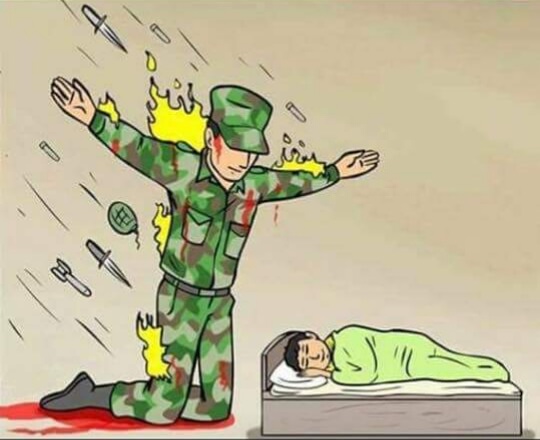
This is a colored drawing in a cartoon style with heavy black outlines and a plain beige background. On the left a soldier in camouflage uniform and a cap kneels. He has spread his arms wide, as if blocking a doorway. His sleeve, shoulder and trouser leg are wrapped in yellow flames, his uniform and face have red stains, and a pool of blood spreads across the floor on the left.
Knives, a grenade and bullets fall around the figure, and all of them are flying toward the soldier. On the right stands a narrow bed: a child sleeps on a white pillow under a light green blanket. The child is drawn calmly and without detail. Nothing threatens them, because the whole blow is taken by the defender. The composition rests on contrast: fire, metal and pain on the left, silence and sleep on the right. The drawing has no captions, flags or insignia.
Where the drawing came from
Reportedly, the drawing first appeared on October 5, 2016, on the Laughing Colours Facebook page, and quickly gathered hundreds of thousands of reactions and more than a hundred thousand reposts. This is the earliest known post, not a proven creation date: the drawing may have been made earlier.
The artist is usually credited as Utkal Gaurab, a comic artist. This attribution repeats across descriptions of the drawing, but it should be treated as a common version rather than an undisputed fact. Which war or conflict the author had in mind is unknown: the scene is not tied to any specific country and works as a general picture of self-sacrifice.
How the picture became a template
At first the drawing was simply shared as a touching illustration. It began turning into a template around the middle of 2017. In May 2017 an edit appeared in which the soldier was replaced by YouTubers from the game Roblox, and in September 2017 a post about the American high school military training program JROTC gathered more than fifteen hundred points on Reddit.
In April 2018 the platypus Perry from the animated series “Phineas and Ferb” appeared in the drawing, defending his neighborhood from danger. In May 2018 a version appeared in which the flying objects were labeled “meme reviews” trying to destroy one beloved meme. A pattern took shape: the soldier's place goes to someone who quietly carries a hard job, the child's place goes to whatever needs protecting, and the threats are renamed to fit the joke's topic.
Why the pattern works
The drawing's strength is that its meaning reads instantly and without words: one figure stands in the fire, while another sleeps and notices nothing. When a minor everyday worry is placed into this frame, a comic imbalance appears. The pathos of the original picture collides with the triviality of the cause, and the viewer recognizes a familiar situation in which the work is done unseen and no thanks is heard.
There is also a second layer: the sleeper knows nothing about the price of their peace. That is why the template is popular for captions about on-call staff, parents, administrators, moderators and anyone who quietly fixes other people's mistakes.
Sample captions
Four captions written for this template are shown below.
Caption for the soldier: “Me”; caption for the threats: “dishes, bills and a call from the bank”; caption for the child: “my morning mood.” Everyday workload looks like a siege, and a quiet sleep becomes something under guard.
“The on-call engineer who fixed every night outage while the team slept.” The serious pose and the fire describe an ordinary night shift. The juxtaposition of heroism and office routine is what is funny.
“While you were sleeping, I answered every chat, and not a single thank you.” The caption adds the defender's voice. The pathos drops away, leaving mild resentment, and the laugh comes from the gap between a heroic act and a petty thank you.
“My cat on night shift: knives, grenades and a paw on the blanket.” The absurd list of threats defuses the drama, while the homey plot stays recognizable.
How to use the template
It is best to keep the “defender and sleeper” arrangement and change only what is flying at the defender. Threats are easy to swap for small things like deadlines, notifications, cold tea or unanswered emails: the smaller the trigger, the bigger the gap with the drawing's pathos.
Do not put real tragedies, actual deaths or photos of real children into this template. The drawing is symbolic and fictional, and it does not need a specific person: the joke rests on the image, not on someone's pain. A short caption works better than a long one, because the drawing has already told the story.