Traffic light versus Roundabout Gang
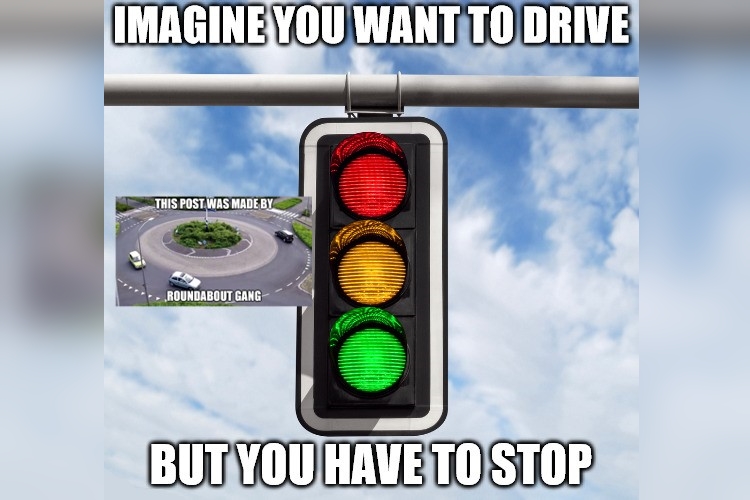
At the center of the image stands a traffic light with red, yellow, and green signals. Above it is written: “Imagine you want to drive,” and below it: “But you have to stop.” In the small inset in the left corner, labeled “This post was made by Roundabout Gang,” a roundabout is shown. The result is a joking dispute not between people but between two road solutions: the traffic light forces you to stop, while the roundabout argues for continuous flow. The note about a “gang” turns an ordinary comparison into a statement made on behalf of a supposedly unified team.
The phrase “this post was made by a gang” works as an invented signature or brand mark. It does not report a real organization: the author attaches any object, game, or habit to a “gang,” and the meme portrays it as a side in an argument. The contrast between the broad complaint and the tiny logo is especially clear here. The main text names the problem, while the inset speaks for a position and a collective voice.
From an internet character to a template with teams
The history of the format is tied to the internet culture of “gangs”: invented groups that ostentatiously supported one thing and mocked another. In early discussions on 8chan, in the /leftypol/ board, users played out the image of the Nazbol Gang, referencing National Bolshevik politics. Early macros also included antisemitic jabs, so the early politicized context differs significantly from the later harmless labels such as Roundabout Gang. It was a meme persona, not a confirmed real organization.
The next notable offshoot was Gang Weed. Its macros combined the Joker as played by Heath Ledger with exaggerated complaints about the situation of gamers and calls for rebellion. A small watermark with the character tied different pictures together: it looked like a recognizable signature of one group, even when the main subject changed. This way of “branding” a meme later came in handy for playful groupings around everyday preferences.
By 2018, similar captions were being applied to other topics. M14 Gang, devoted to the M14 rifle from Call of Duty: Black Ops, appeared on Facebook in September. After PewDiePie was mentioned in a Meme Review episode on September 25, more viewers learned about the group. Soon new “gangs” and parodies began appearing on Reddit: instead of one specific group, any author could declare that supporters of their taste included gamers, coffee lovers, or fans of a single route. Dated posts show how quickly the formula spread in that period, but they do not establish a single moment of its creation.
Why a label sounds like a collective statement
The format has two voices. The upper caption usually speaks for an individual: they dislike some thing, or they find themselves in an awkward situation. The small emblem answers on behalf of a group, as if the irritation had a club, a flag, and permanent supporters. Because the scale is disproportionate, even a minor preference takes on the appearance of a serious confrontation. That is why one can pit a traffic light against a roundabout, but just as well a physical button against a touchscreen.
Invented joke factions
For example: “When an app insists on updating right before a call,” and the caption reads “This post was made by the ‘Remind me later’ button Gang.” Here the team supports the function that rescues you from a bad moment. “When the café runs out of drip coffee,” and the mini emblem announces “Instant Coffee Gang”: the conflict is built on the choice of drink. Or: “When the game needs the tutorial again,” and “Spacebar to Skip Gang” champions a quick return to the action.