What is visible in the frame
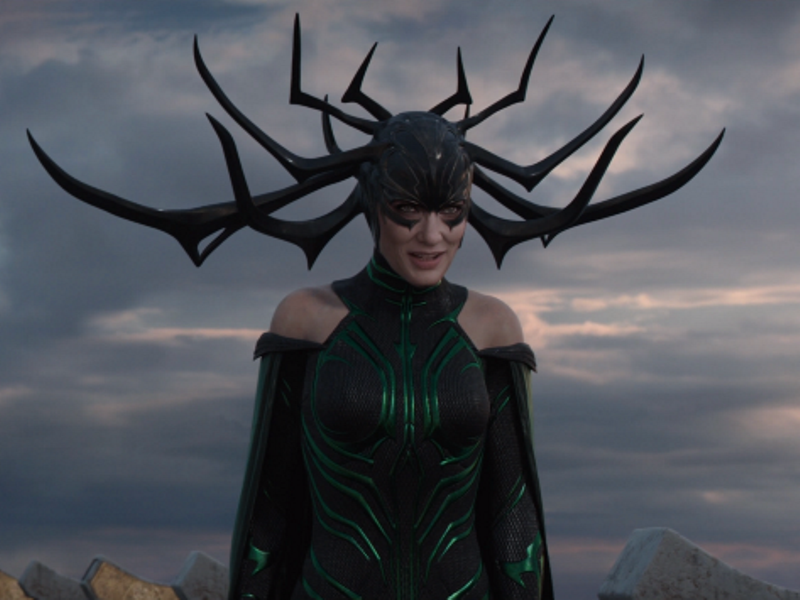
The shot shows a character in a black form-fitting costume with green glowing lines and a dark helmet with long branching horns that spread to the sides like a deer's antlers. The face has dark markings around the eyes, the gaze is aimed straight at the viewer, and a predatory half-smile sits on the lips. The shoulders are bare, and a dark cloak hangs behind them. Behind is a heavy cloudy sky and rocky outcrops along the bottom edge.
This is Hela, goddess of death, from the film “Thor: Ragnarok” (2017). For the meme what matters is the image, not the actress: the horns, gloomy palette and confident pose make the frame resemble a portrait of a winner who has not yet suspected anything.
Lines and the plot twist
In the film, Hela says that whatever the opponents plan, nothing will work out for them and she cannot be defeated. Thor replies: “No, I know. But he can.” “He” refers to Surtur, the fire giant whom Loki freed by placing his crown in eternal flame. Surtur grows and begins to destroy Asgard.
The reply is built on concession: Thor does not argue with the statement, he agrees with it and immediately flips its meaning. The boasting stays unchallenged but loses significance, because a force of a different scale enters the game.
How the template turned into a series of panels
In memes the lines are split into two parts. The first caption belongs to the confident character: he boasts that everything is under control. The second begins with “No, I know. But he can” and names the one who will still prevail. There are often several panels, and each introduces a new, increasingly unexpected opponent.
The exact time the format appeared is given differently; the earliest examples are dated to summer 2018. These are early known examples, not a proven first publication, so the exact author and exact date of the template's appearance cannot be named.
Examples of captions
First example: “You can't defeat me” and “No, I know. But he can: Monday.” The boasting gives way to a threat from everyday life, and the shift in scale makes the joke understood at once.
Second: “I'll get everything done before the deadline” and “No, I know. But he can: the alarm clock that didn't go off on Saturday.” Here the expectation of drama collides with a trivial everyday detail, and the disproportion is what's funny.
Third: “Diet, you won't break me” and “No, I know. But he can: the smell of fresh bread.” The construction is the same: the first line sounds confident, the second introduces a stronger opponent, and that opponent turns out to be not a monster but an ordinary temptation.
Why the picture works
The frame sets a dramatic tone: the dark palette, horns and clouds give any caption weight. That is why even an everyday phrase sounds like a prophecy, and the irony rests on the contrast between the solemnity of the picture and the banality of the second fragment.
The template works best for situations where a person sincerely feels sure of their strength, and reality throws in a small but insurmountable obstacle. The more specific the second point, the funnier: “Monday” will work worse than “an email that arrived on Friday at 18:01.”