Description of the shot
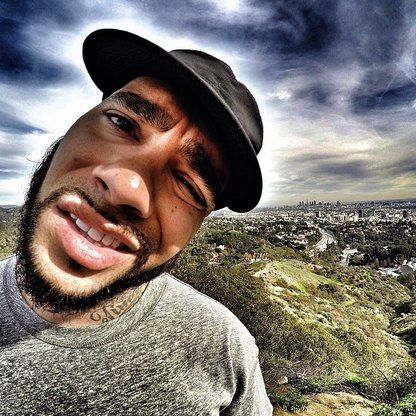
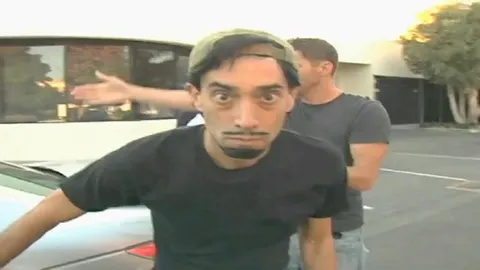
The photo is taken as a selfie: the face is in extreme close-up, tilted to the left. The man is wearing a wide-brimmed black bucket hat, has a beard and mustache, one eye squinted, and his mouth slightly open in a sly smile. A fragment of a tattoo is visible on his neck. Behind him is a hilly landscape with greenery and a city on the horizon, under an overcast sky with bright patches breaking through.
The shot is attributed to the rapper Timati, although the person can't be identified from the image itself. The caption "Are you Slava Marlow?" serves as the meme's title, but it doesn't actually appear on the image itself.
Who is Slava Marlow
Slava Marlow is a Russian music producer, beatmaker, and YouTuber, born in 1999 in Novosibirsk. He gained recognition through his work with the rapper Morgenshtern starting in October 2019, in particular on the album Legendary Dust, released on January 17, 2020. That same year he released the track "TikTok Challenge," which became very popular on TikTok.
The name became a meme not because of the song but because of the question: the caption "Are you Slava Marlow?" is used as a joking complaint or expression of surprise when one person looks or behaves as though they were someone else.
How the joke originated
According to one explanation, the joke appeared in 2021 and is based on a photo of Timati that he posted on Instagram around 2015. Users compared his facial expression there to Donkey from the animated film Shrek. The question about Slava Marlow was later added to this photo, as if the person asking wasn't sure who they were looking at.
This hasn't been confirmed by a second independent source, so the exact connection to Donkey, the year the original photo was published, and the first example of the joke remain unverified. The only thing reliably known is that the meme spread in 2021.
How the question works
The joke relies on comic bewilderment: the person in the photo looks on with a squint, as if he himself doubts what's happening, and the question, voiced from the viewer's perspective, reinforces that. There's no answer built into the meme — the viewer decides for themselves what "yes" or "no" would mean.
It's a joke about mistaken identity and about how celebrities can have look-alikes in the public eye. There's no serious offensive meaning in it as long as the question isn't taken too seriously, but no traits should be attributed to the person in the photo either.
Caption examples
Caption: "The delivery guy, when I open the door without warning" — the squint reads as distrust toward whoever opened it. It works through a relatable everyday situation.
Caption: "My cat, when I call it by name and it looks at me like I called the wrong one." The squint in the photo reads as a silent "you clearly have no idea who you're looking at," and the question "Are you Slava Marlow?" fits here almost literally.
Caption "Are you Slava Marlow?" under a photo of a friend who showed up with a new haircut — a friendly joke about not being recognized. It's best to use it only with the friend's consent.
Caption "When someone in the chat writes that it wasn't them" — a version about doubting who's actually speaking.
What to keep in mind
The template is most convenient as a reaction to dubious claims and inexplicable coincidences. It shouldn't be used to caption photos of real people without their consent: the meme is easily read as mockery of someone's appearance.
A short caption is stronger than a long one: the look on the face in the photo is already expressive enough.