What the picture shows
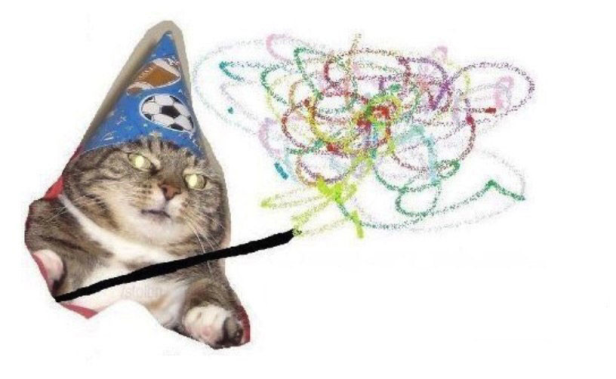
At the center of the picture sits a striped tabby cat against a light background. On its head is a tall blue hat patterned with soccer balls and stars, and its front paws hold a black wand. Colorful spirals and loops burst from the tip of the wand, stretching upward and to the right, filling all the empty space. The cat's eyes are light-colored and wide open, and its muzzle looks tense and serious.
The contrast between the cat's serious expression and its playful hat creates a comic effect. The cat looks as though it's taking the sorcery very seriously, and it's exactly this deadpan composure that makes the image funny. The chaotic, multicolored trail from the wand hints at a magical effect that has just been produced, giving the viewer the sense that the miracle has already happened.
How it came about
The photo of the cat in the hat itself spread widely across the English-language internet around 2013. The photo turned up in roundups of funny animal pictures and acquired various captions, in which the cat played a comic role. The picture appeared in the Russian-language space later, but by the time the meme was born it was already familiar to many users.
The key moment came in late 2016. One of the authors of a themed community paired the cat with a short caption that, for the first time, included the word "vzhukh." The post itself got almost no attention, but the picture quickly spread across the Russian-language internet, including through users' tweets. Soon someone cut the cat out of its background, drew in a magic wand with colored swirls, and added the sound effect "vzhukh." It was this version that became the basis of the meme.
According to the caption's author, the word was suggested by a friend who often said "vzhum-vzhum." So the meme doesn't have a single documented creator in the usual sense: the picture and caption were shaped by a chain of users, each of whom added their own detail.
How the meme is used
The meme's typical format is the caption "Vzhukh, and you...", followed by the desired outcome. For example: "Vzhukh, and the deadline is pushed back," "Vzhukh, and the report is done," "Vzhukh, and you're already on vacation." The picture is usually paired with a situation in which the needed action has already happened, showing a wish granted in an instant.
The meme is especially popular during stretches of tight deadlines and in the run-up to New Year's, when people wish the work would just finish itself. In themed communities it's often posted as an ironic wish: vzhukh, and everything's done; vzhukh, and the holidays are already here. Used this way, the magic word becomes a joking way of admitting one's own laziness.
There are also more absurd variants, where the wand gets applied to unexpected things: cleaning the apartment, finding one's keys, or getting paid. Captions like these work on the contrast between the cat's serious look and the mundaneness of the wish, and the image itself adapts easily to any storyline.
Why the meme caught on
The main asset of "Vzhukh" is its short magic word, easy to say and easy to remember. It sounds like a sound effect out of a fairy tale and immediately sets an ironic tone, so it can be dropped into all sorts of conversations without needing to explain the context.
The second reason is visual universality. The cat in the hat with the wand is instantly recognizable, and the colorful trail from the wand can be drawn in for any storyline. That let the meme live on as templates and themed communities, where users shared their own variants and built on each other's ideas.
Finally, the meme combines two motifs: the dream of magic and the everyday wish to get unpleasant chores over with as fast as possible. Thanks to that, it works as self-deprecating humor about procrastination: there will be no miracle, but one can at least laugh about wanting one, and it's exactly this light touch that has helped "Vzhukh" stay part of internet humor for many years.