The commercial that started it all
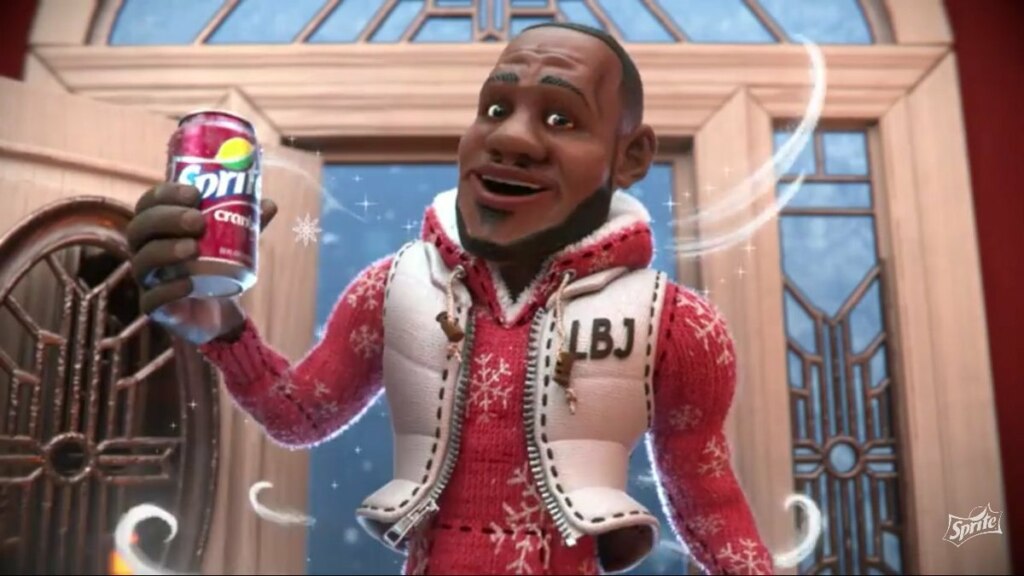
The ad came out for the 2017 holiday season and promoted a new flavor of soda, Sprite Cranberry. The main character was an animated version of basketball player LeBron James, who was the face of the campaign. The first video was uploaded to the brand’s YouTube channel on November 17, 2017; the song in the commercial was performed by rapper DRAM together with the character.
The ad’s meaning is simple: the character appears at a door in winter weather and offers to try the drink, and the holiday is presented as a time when you especially want something to drink. What is remembered from the commercial above all is the melody with its repeating chorus.
What is in the frame
The picture shows a stylized animated figure with a little beard and a wide smile. He wears a red knitted sweater with snowflakes and a light vest with the letters LBJ on it. In a raised hand is a can of Sprite Cranberry in red packaging. Behind him is a wooden door with patterned glass; outside, snow is falling, and the brand logo is in the corner.
This is not a photograph but an advertising character, so memes with him usually refer to the commercial and the melody, not to the private life of the athlete.
How the commercial became a meme
The meme began with remakes. By the end of November 2017 a version appeared on YouTube in which the sound was deliberately made sharp and grating, and then other users started remaking the commercial. Then screenshots with their own captions began circulating on social networks, and the character turned into a template.
The melody and the phrase played the main role. “Wanna Sprite Cranberry?” is repeated so often that it is easy to remember and to insert into any situation. Since it is a question, one wants to answer it, so the phrase easily opens any caption.
Why remixes work
The commercial has a sharp contrast: a quiet winter picture and a very energetic hero who offers a drink as if the holiday depended on it. Such a shift is easy to amplify with sound and editing, which is exactly what the remake authors did.
The second mechanism is repeatability. The phrase sounds like a simple question, so it can be placed at the start of a caption, and a frame with a smile and a can becomes a ready-made sentence. The more unexpected the situation in which the question sounds, the funnier it is.
Three captions and how they’re built
Examples invented for the template.
“Wanna Sprite Cranberry?” — “No thanks, I’ve outgrown holiday flavors.” The phrase from the ad becomes a question to the interlocutor, and the confident refusal breaks the expectation.
“Wanna Sprite Cranberry?” — “First tell me what the cranberry is about, and then I’ll think.” The joke rests on distrust: the hero waits for an answer, and the interlocutor demands details.
“You promised to come by nine. Wanna Sprite Cranberry?” The ad phrase sounds like a gentle reproach to a friend: a cheerful question about a drink contrasts with being late.
How to use the template
The frame is handy for captions where the character offers something unexpected and the viewer refuses or asks a counter-question. The hero is pleased and smiling, so it’s better to build the caption on the contrast between cheerfulness and what is being offered.
It is better to joke about the commercial, the drink, and the habit of repeating other people’s phrases than about the appearance or private life of a real athlete.