What the picture shows
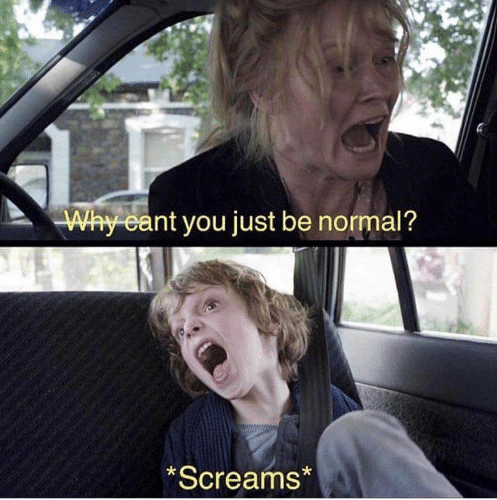
The meme is a two-panel frame. On top, a blonde woman behind the wheel turns around with her mouth open in a shout; the caption reads “Why can’t you just be normal?”. Below, a boy in the back seat, buckled into his seatbelt, is also shouting with his mouth wide open; his caption reads “*Screams*”.
Both frames come from the same scene in the Australian horror film The Babadook (2014, directed by Jennifer Kent), in which the mother, Amelia, worn out by her son Samuel’s behavior, snaps at him during a car ride, and the frightened, overexcited child answers with a hysterical scream.
Origin: a frame from The Babadook
The Babadook came out in 2014 and won critical acclaim as a psychological horror film about a mother suffering from chronic sleep deprivation and grief after her husband’s death, and her difficult son, who believes in a monster named Babadook. The car-shouting scene is one of the film’s emotional peaks, illustrating the mounting tension between the characters.
The frame did not become a meme right away. According to English-language meme encyclopedias, individual screenshots and GIFs of the mother and son shouting began circulating online in the late 2010s, against the backdrop of the film’s broader popularity as an internet phenomenon (the Babadook character had already become a meme in its own right, including within the LGBT community on social media). The stable “Why Can’t You Just Be Normal / *Screams*” template as a two-caption format took hold much later, mainly through reposts on Twitter/X, Reddit and TikTok.
How the format is used
The meme has become a universal template for “inadequate communication”: the top panel stands for a reproach, complaint or question from one side, and the bottom panel for a disproportionate, irrational or hysterical reaction from the other instead of a rational answer. The two captions are often rewritten for a specific situation, while the core idea of “screaming instead of answering” stays the same.
Typical variations: on top, “Why can’t you just finish this soup,” and below, “*Screams*”; or on top, “Why haven’t you done your homework again,” and below, “*Bloodcurdling scream*.” The humor comes from the contrast between a mundane, often trivial reason for complaint and a grotesquely strong reaction — the drama of the horror still works here as a comic device.
Why the format proved convenient
The template’s popularity is due to its flexibility: it fits domestic family situations, work correspondence and political arguments equally well, and even memes about pets, where a cat or dog stands in for the people. The expressive faces of both characters — wide-open mouths, tense postures — read without any context from the film, so the audience doesn’t need to have seen The Babadook to get the joke.
The two-part structure (reproach on top, absurd reaction below) also fits the familiar format of reaction memes and is easy to edit in any graphic editor or online meme generator, which sped up its spread in the 2020s.
Place in the broader context of “Babadook memes”
“Why Can’t You Just Be Normal” sits alongside other internet jokes about The Babadook. The titular monster itself has been the subject of many memes since the mid-2010s, including a playful “coming out” as a symbol of the LGBT community after the film was miscategorized on Netflix. The car-shouting frame in particular broke out as a separate, standalone format, not tied directly to the film’s plot and perceived as an independent unit of humor about generational conflict and failed communication.