What is depicted in the frame
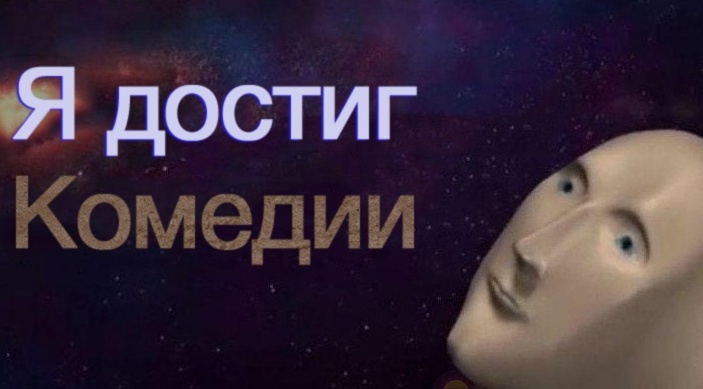
At the bottom right, a tilted smooth pale head with blue eyes and a sharp nose peeks in from the edge of the frame. This is Meme Man, a three-dimensional model of a head without hair and with a slightly empty gaze. The character’s eyes are open, not closed. On the left, against a dark background with stars and a nebula, the words “I have achieved” are set in large letters, and below them, in another typeface and in golden color, “Comedy.”
The cosmic background and the grandiose caption serve as contrast: this is usually how one presents an account of a great discovery, not of a joke. The head, meanwhile, looks up and to the side, as if watching something distant and important.
Where Meme Man came from
The character itself is older than this caption. According to descriptions, the gray smooth head first appeared as a clumsy three-dimensional model on the 4chan board dedicated to 3D graphics, and the page author Special meme fresh made it the avatar of their Facebook community on August 9, 2014. That is how the image became the mascot of surreal memes.
The most famous work with this hero, a picture with the word “stonks” and an upward arrow, appeared on June 5, 2017, and spread across Reddit. It was after this that the model began to be inserted into all kinds of collages, including Russian-language ones.
What is known about the caption itself
Who first combined the head of Meme Man with the words “I have achieved comedy,” and when, cannot be reliably established. The phrase looks like a translation or reworking of an English formula about achieving comedy, but there is no data on the first publication, so naming a date and an author would be made up.
The mechanics, however, are clear from the frame itself. The exaggeratedly serious design announces the summit of humor, and anything can be substituted under it: from a pun to an utterly meaningless set of words. The weaker the joke, the funnier the self-satisfied declaration sounds.
How the joke reads
The meaning is built on the gap between the scale of the declaration and its occasion. So a person declares that they have reached the peak, even though they have just said something quite simple or not funny at all. The listener laughs not at the joke but at the confidence with which it is delivered.
A second possible reading is more ironic: the caption is applied to other people’s texts that accidentally turned out to be genuinely good, and then it sounds like playful praise. Which variant is meant is determined by the context, so one and the same template works both for self-irony and for friendly teasing.
Caption examples
“I bought a plane ticket, and the name of the airport turned out to be funnier than anything I’ve heard today” — the words under the picture turn an everyday trifle into an event of cosmic scale.
“Spent three hours writing a pun about a cactus and accounting” — the caption works on contrast: the effort is enormous, the result is dubious, and the picture solemnly confirms it.
“A friend sent a sticker with a cat in a hat: I looked at it, and suddenly everything was funny” — here the template serves as a sincere reaction to a trifle that unexpectedly turned out to be good.
How to use the template
The image works best as a reply to a joke in a chat: it can be sent without words, to award the author the highest prize with an ironic gesture. If you want self-irony, add your own caption in which the reason for pride is deliberately trivial.
Try not to stretch the text. The large two-word inscription is already on the picture itself, and any extra long comment destroys the solemnity on which the grotesque relies.