What the frame shows
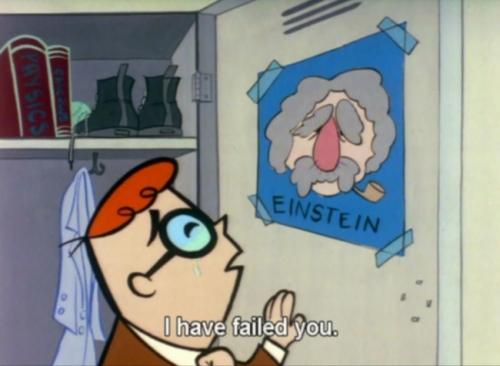
On the left is Dexter: a red-haired boy in round glasses, dressed in brown. A tear rolls down his cheek, his head is raised, and his hand reaches toward the poster. On the right, on the door of a cabinet, hangs a blue poster of a caricatured Einstein, fixed with tape at the corners: tousled gray hair and a mustache, a large pink nose, a pipe. Below the portrait is the word "EINSTEIN." On the left shelf there is a red book labeled "PHYSICS" and dark boots, and a white lab coat hangs on a hook. At the bottom is the subtitle: "I have failed you."
This is a screenshot with the built-in English subtitle, and the words "I have failed you" are part of the frame. In Russian-language jokes, people more often use a translation or replace the text altogether.
Which episode the moment comes from
The scene is from the first-season episode "Dexter's Rival," which English-language reference sources date to 12 May 1996. In it a new student, Mandark, turns out to be more successful than Dexter at school, and the young inventor has to shut down his lab. The hero addresses the Einstein portrait hanging on the door and says this line.
First-airing dates vary between reference works, so the date should be treated as approximate.
The route to the internet
The frame became usable for substitutions in the early 2010s: the first edits that swapped Einstein for other images are dated roughly to 2013. The format became truly mainstream later, closer to the end of the 2010s. All these dates are approximate, and the very first example is hard to identify.
The mechanism is simple: the frame reads without explanation, and the poster is easy to cut out and replace with anything.
Why it is funny
In the original, the scene is tragic, and the hero's tears are sincere. In memes, something trivial takes Einstein's place: a half-eaten sandwich, an alarm clock, a to-do list. The more absurd the object of "respect," the sharper the comic gap between the pathos and the cause.
The reverse also works: the poster shows something genuinely significant, while the caption reveals a minor offense.
Captions for replacing the poster
Poster: a plate with half-eaten pizza. Caption: "I have failed you." The last slice is left untouched, and the joke turns into a domestic drama.
Poster: a to-do list for the week. Dexter looks like someone who on Friday realized he has done almost nothing.
Poster: a diploma. The caption says that instead of preparing, you were rewatching TV series. The guilt is presented solemnly, and the cause is mundane.
Poster: a favorite cat. Dexter cries because he was a minute late with the food. The pathos is unjustified, and that is the joke.
Practical tips
The template works best when the object replacing the poster is recognizable and needs no explanation. Keep the tape at the corners and the poster's general proportions: these details make the replacement convincing.
You can keep the subtitle or replace it with your own text, but it is better not to change the formula itself, since it is the recognizable part of the joke.