What is pictured and where the joke is
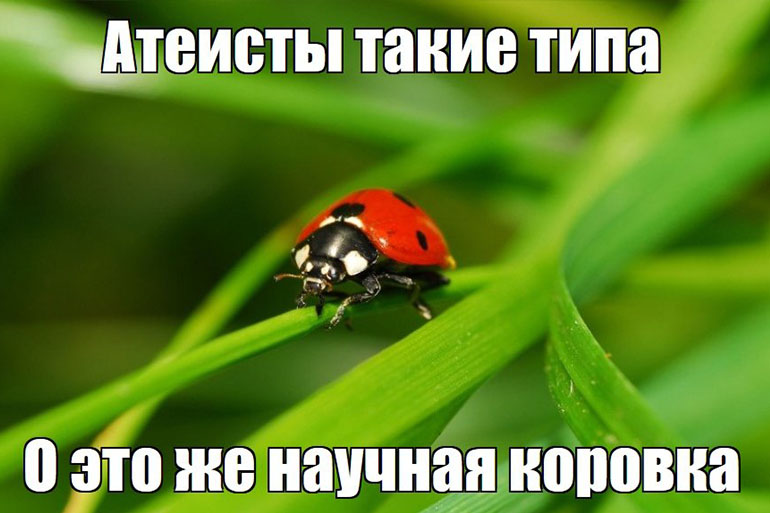
A small red-and-black ladybug sits on a large green leaf; the top caption reads 'Atheists be like', and the bottom one 'I adore scientific little cows'. The joke depends on Russian: the ladybug is called 'bozhya korovka', literally 'God's little cow', and here 'God's' is deliberately swapped for 'scientific', as if the speaker were trying to strip any mention of God even from the established name of an insect. The picture of the insect itself has nothing scientific about it. The comic effect comes from the caption and from reading a familiar phrase literally.
A stereotype as the target of parody
The template mocks a cartoonish idea that an atheist must avoid every word with religious associations and replace it with scientific terms. This is hyperbole, not a fact about how non-religious people behave. Atheism is the absence of belief in a deity, or a position on the existence of gods; it is not in itself a cult of science. Science is a method of studying the world, not a set of new sacred names for things. The meme oversimplifies complex discussions by deliberately pushing word substitution to the point of absurdity.
Playing with set expressions
The working mechanism is to take a familiar expression and swap one element so that the result resembles an artificial ideological rule. 'Scientific little cow' sounds almost like a real name, so the picture supports the pun. In new versions the subject changes and it need not be religion: 'astronomical dust', 'engineering owl' or 'mathematical Monday' can parody an obsessive urge to label ordinary things with words from a profession. It is important that the substitution stays recognizable and does not turn the joke into mockery of any particular person's beliefs.
New examples
The same mechanism gives captions like: 'I don't say "lucky break", I say "statistically favorable outcome"' — the ladybug's deadpan stare does the rest of the joke. Another common version sticks to the word swap itself: 'I don't eat breakfast, I perform a daily caloric intake procedure,' delivered with total seriousness. In the religion-and-science version you can write 'I avoid the word "little star" and say "small celestial object"' and add a character with an extremely serious face. These are original examples that illustrate the exaggeration, not real phrases used by any community.
Context and a friendly tone
The template can start a conversation about language, but it easily turns into a quarrel if the stereotype is passed off as a trait of all atheists or all believers. It is better to aim the joke at the literal word swap and the excessive seriousness, not at people's right to hold or not hold religious beliefs. The picture contains a ready-made caption; it cannot be treated as a documentary quote from a particular author's post without further checking. In other text variants, it is important to separate the invented 'replacement' from scientific fact. 'Ladybug' is an ordinary everyday name for the insect, and the meme does not actually rename it.
The text also has a second reading: it nods to how a worldview dispute can seep into the most everyday words. The more ordinary the object in the picture, the more obvious the disproportion of the substitution. But this mechanism should not be used as if every person who does not believe in God must treat science as their own religion. That is a false generalization built into an exaggerated image, not a conclusion from scientific or sociological data.
What survives the joke is the ordinary word 'ladybug' itself: the meme never seriously proposed renaming the insect, only renaming the speaker's vocabulary for a punchline.