What is depicted
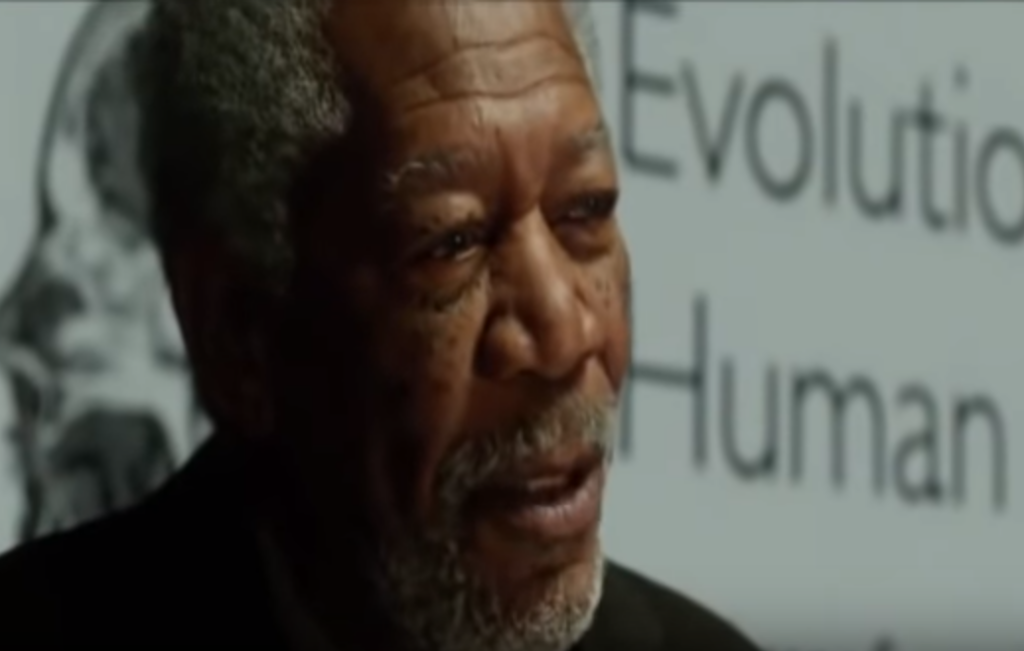
The shot shows an elderly man with short gray hair and a thick gray beard. He is filmed in close-up, looking to the left, lips slightly parted as if he is speaking. He wears dark clothing. In the background is a light screen with large letters cut off at the edge: parts of the words “Evolutio” and “Human” can be made out, and on the left a semi-transparent silhouette of a head is faintly visible.
The scene resembles a lecture, and this matches the film: in Lucy, Morgan Freeman's character, Professor Norman, gives exactly such a lecture. There is no meme text on the image itself; the caption phrase is added separately.
The ten percent myth
The idea that a person uses only ten percent of the brain has long lived in pop culture. In the film Lucy (2014), Freeman's character reasons that people use only a small part of the brain's capacity, and the plot is built on the heroine gaining access to a larger and larger percentage. The film, however, presents science fiction, not science.
Neuroscience does not support this myth: without serious damage, a person engages virtually the whole brain, and different areas are active even during sleep. So the question “what if we used all 100%” rests on a false premise, and that is exactly what makes it good material for irony.
Why the caption works
The meme plays on the gap between the film and reality. The caption asks “what if we used 100%,” as if it were about future superpowers. The viewer recognizes a familiar idea and laughs at the fact that it is taken seriously.
The lecturer's serious face intensifies the effect: he looks like a man who knows the answer. That is why captions work best when a loud question is followed by an everyday, down-to-earth answer that breaks the pathos.
Caption examples
Below are variants made up for illustration. All of them keep the opening “what if we use 100%” and turn the pathos into a mundane detail.
“What if we use 100% of our brain, and it asks us to take out the trash.” Funny because of the abrupt shift from superpowers to a household request.
“What if we use 100% of our brain and it turns out the keys are in the fridge.” A small absurdity that almost everyone understands.
“What if we use 100% of our brain but still can't remember the Wi-Fi password.” The contrast between promised power and familiar forgetfulness makes the caption recognizable.
The reverse also works well: the caption promises a grand discovery, and it turns out that even with 100% of the brain a person still puts things off until tomorrow. The more mundane the ending, the stronger the effect.
How to use this template
The frame suits jokes about scientific myths, everyday “superpowers,” and phrases that are often repeated in movies. If the caption refers to ordinary situations, the effect is stronger than with abstract reasoning.
Do not turn the meme into a claim about the brain's real capabilities. The brain is almost entirely engaged, and it is not worth attributing scientific claims to Freeman outside the film: his character says the line within the plot, and the meme works precisely with that plot claim.