What's shown in the picture
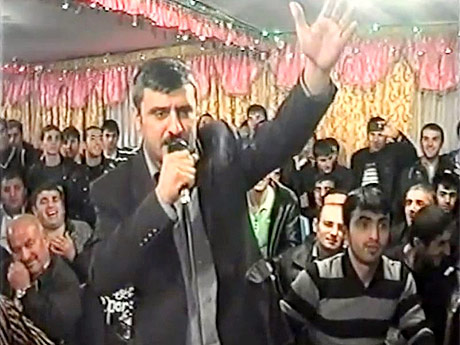
In the frame, a man in a dark suit stands in front of an audience with a microphone in one hand, raising the other in a gesture typical of emotional performance. Around him, spectators sit and stand, some watching the stage with a smile, others busy with their own affairs. The setting is festive: pink and gold decorative drapery sets a celebratory mood.
The shot conveys the genre's main feature: the performance here is less a concert than live interaction with the audience, where the performer is the center of attention and addresses the guests directly. The contrast between the lavish festive setting and the abrupt phrase is what makes the image recognizable.
The shot itself carries no caption: it's recognized by the setting and the gesture, while the text of the phrase lives on separately from the image.
Origin and first publication
The video was filmed on November 5, 2011, at a wedding in the Azerbaijani village of Tangarud. The performers were brothers Intigam and Ekhtiram Rustamov, who performed in the genre of meyxana, an improvised rhyming exchange. In this genre two sides trade verses, and whoever comes up with the wittier rhyme wins. In the clip, speech is heard in Azerbaijani, Talysh, and Russian.
The phrase roughly means "I don't want to know you, get out." The clip had gathered more than 25 million views on YouTube as of August 2024, and a separate version on the Insanity TV channel had collected more than 10 million.
Path into the Russian-language internet
A hashtag with this phrase began spreading on Twitter on May 29, 2012, and hit worldwide trends the next day. It was quickly picked up in public contexts: a representative of an automobile organization used the line in an address to Vladimir Putin, and placards with a rephrased version of the slogan appeared at Russian pickets.
In August 2012 the Georgian opposition released its own version addressed to then-president Mikheil Saakashvili, and on September 1 of that year the phrase appeared on protest placards in Yerevan against the extradition of Ramil Safarov to Azerbaijan. Remixes and samples of it were used in dubstep and techno mixes, and Timati took the motif for a diss track against Philipp Kirkorov.
The phrase also turned up in a sporting context: during the broadcast of the Sweden-Ukraine match at Euro 2012, commentator Viktor Gusev used it. Thanks to such references, the line became established as a universal joke.
How it's used and why it works
In messaging, the phrase serves as the final word in an argument: people write it when the other person has become tiresome or when they want to close a topic with one sharp reply. It's most often paired with the video clip or a quote delivered with deliberately solemn flair, to underline the irony.
The comic effect rests on the contrast between the formal, almost ceremonial genre of improvisation and the everyday refusal to keep talking. The rhythm of the short phrase and the melodic quality of the refrain make it memorable, and the structure itself allows for endless variation. The joke isn't built on mocking a nationality: the meme works as a universal form of dismissal that can be applied to any annoying interlocutor.
The line is understood both by fans of the music and by viewers unfamiliar with meyxana, since the meaning of the refusal doesn't require knowledge of the tradition.