Homework with a real model
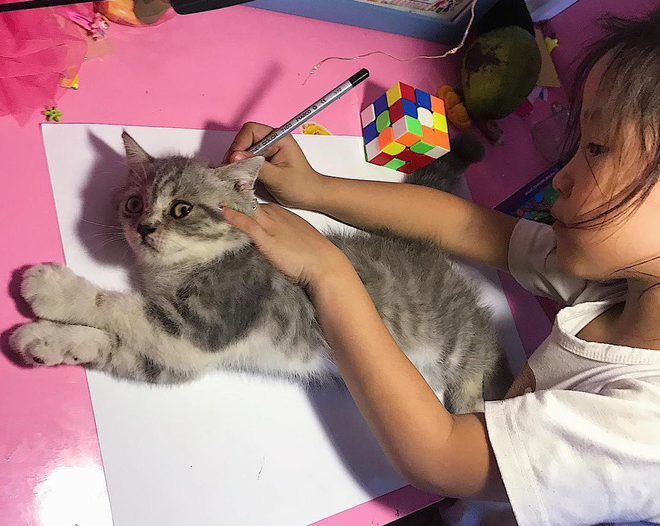
In the photo, the girl holds a gray cat on a large sheet of paper and guides a pencil around its body. Colorful objects and a Rubik's Cube lie nearby; it is an ordinary home setting, not an artist's studio. The picture started as a family joke about an assignment to draw your own cat: instead of drawing the animal from memory, the child placed it on the paper and traced its silhouette. The original account belongs to Nguyen Quang, who wrote that the girl is his younger sister and that she had been asked to draw the family cat. Paired with a photo of the result, it became a short story about taking an assignment too literally.
Dates of the photo and its viral spread
The original Instagram post is dated August 2, 2018. It showed photos of the girl at work and the finished drawing. Several weeks later, on August 26, 2018, the images were posted to Twitter; the very next day a version with the captions “me” and “life” appeared. On August 28, a comparison of Apple Music and Spotify spread on Reddit, and then new pairs with other brands and ideas followed. Within three days, the family joke about homework had become a format about resemblance and imitation.
How the "model and copy" pair works
In the common version, the viewer sees the source and the result side by side: the fluffy cat sets a complex shape, while the drawing keeps only a rough outline. The captions can label a product and its imitator, an idea and its execution, an original work and a retelling. The humor does not necessarily require a mean comparison: sometimes the copy simply repeats the surface too literally, without understanding what makes the source recognizable. The photo's details support this mechanic: the cat is not a schematic silhouette but a living creature that is hard to keep in one pose. So the scene shows both the child's practical resourcefulness and the comic mismatch between the task “draw” and the solution “put it on the paper.” When the format moves to goods, ideas or skills, the reader can instantly tell who is the model and who is trying to reproduce it.
Invented pairs
Imagine a table labeled “original service — clone app”: the first half shows a handy route search by map, while the second copies the colors and buttons but cannot find the street you need. The difference between surface resemblance and a working function is visible at once, with no extra explanation. In another case, the captions “textbook” and “summary from memory” can be placed over a page with a detailed diagram and a sheet where only three arrows remain: the copy simplifies the material until the connections between parts are lost. Finally, in an invented chat, a friend tries to retell a complicated meme but remembers only the general arrangement of the characters and completely forgets the joke itself. The cat in the original frame remains a handy marker of this contrast: a living, moving model is harder to capture in an exact line than it seems, and the traced outline almost always reveals exactly what the imitator missed or considered unimportant when carelessly repeating the shape of the original.