Red background, a scream and flying knives
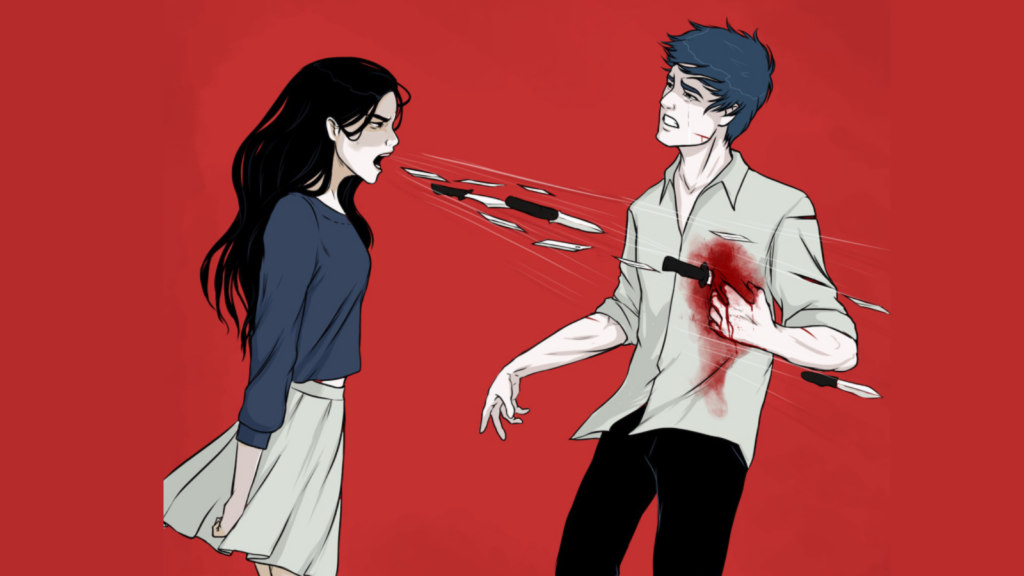
The image is almost a single color: a saturated red background against which two figures stand out. On the left stands a girl with long black hair in a blue sweater and a light skirt; she is screaming with her mouth wide open. From her mouth knives fly in a straight line, of various sizes, from thin blades to a large knife with a black handle.
On the right is a boy with blue hair in a light shirt: his face is twisted with pain, one hand clutches his chest where a knife sticks out, and a bloodstain has spread across his shirt. Several more blades fly past and cut through the air. The drawing is styled as a modern comic, with crisp outlines and flat color fills.
Who drew it and what it was meant to say
The author is Russian artist Alena Sofronova. The illustration was called “The Most Terrifying Weapon” and appeared in September 2018 on a Russian website about creativity and design. Its meaning was serious and unambiguous: words can wound deeper than any knife.
For the meme this is an important fact: the original idea was a metaphor about the cruelty of words, and no jokes were built into the drawing. It became a joke later, when viewers noticed how dramatic and at the same time universal the composition itself is.
How the drawing became a template
In 2018–2019 the picture spread through Russian social media as an expressive illustration of quarrels. It became a meme in July 2019: first in Portuguese-speaking communities, and by autumn 2019 in English-speaking ones too. When the format reached Russian-speaking users, and what the first Russian joke was, is not reliably known.
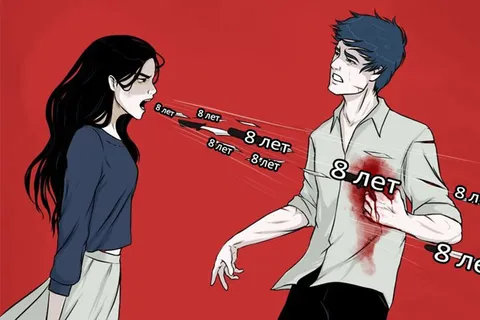
The format that caught on uses a caption like “No, I won't...”: instead of a serious accusation, the heroine yells a petty everyday refusal. The template's Russian name points to exactly this pattern.
Why it's funny: scale against cause
The contrast does the work. The drawing shows the heaviest possible reaction, a weapon that pierces a person through. The caption, on the contrary, reports a trivial cause. The smaller the reason, the bigger the gap and the funnier the result.
The second device is the assignment of roles. The girl in the role of the one who refuses and the boy in the role of the one the refusal wounds can be replaced by any people, animals or objects. That is what makes the template flexible.
Caption examples
Caption above the girl: “No, I'm not going to watch this movie in the original with subtitles.” Here the harshness of the refusal is immediately explained by a mundane reason, while the boy takes the hit for his idea of spending the evening differently.
Above the boy: “Me, when I said that this time I'd choose where we eat.” The hero becomes a victim of his own boldness: the scale of the consequences is out of proportion to the question.
Above the girl, with the words in quotes: “I won't call back, I'm having a quiet day.” The joke rests on a recognizable life situation: the refusal sounds mild, but the consequences are drawn as a catastrophe.
A reversed version: the girl's caption is “The coffee in the office ran out,” and above the boy, “The colleague who drank the last cup.” The roles are swapped: the speaker stands for society, and the one who gets hit is the culprit.
How to use the template
A caption works best when it is short and in direct speech: then the viewer hears the scream right away. The topic should be everyday, almost funny in its smallness, otherwise the contrast disappears.
Keep in mind that the picture shows wounds and blood. It is drawn in a stylized way and suits irony, not captions that joke about real violence or a specific person.