Four traces in a few seconds
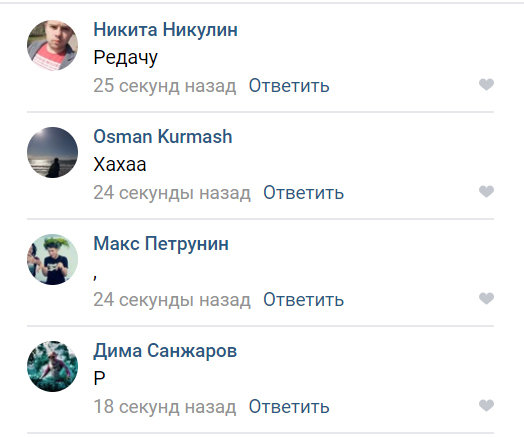
The image shows four comments with avatars and names. Under the first is written “Redachu,” followed by “Hahaha,” a comma, and a separate “R.” The timestamps report 25, 24, 24, and 18 seconds before the moment of the snapshot. Next to them are reply links and gray hearts, but there are no reaction counts. The post itself is not in the frame, so it is unknown what material the people are commenting on. This snapshot also does not show whether they later changed their messages.
The comma and the letter are especially expressive. They look like the beginning of a thought sent before it was finished. The word “Redachu” almost directly announces this in-between mode: the spot is already taken, but the content is still being prepared. Not every short comment is necessarily a placeholder — laughter can be a complete reaction on its own. But the proximity of several minimal messages and their close timestamps create the impression of a shared race, in which participants try to make themselves visible as quickly as possible.
Continuing the race for first place
The name comes from the colloquial “redachit,” meaning to edit. The practice continues an older habit of writing “first” under a fresh post. When a message can be changed, the early position is separated from the content: first some brief sign appears, and a suitable joke is invented only after sending. By May 2018, redacheri were described as a noticeable type of participant in VKontakte meme communities. This habit has no single established founder, and the date of this particular screenshot is unknown.
Within the same culture, commenters whose successful replies were forwarded together with the original post became known. One such participant is Artur Molotov, who created the community “The Great Commentator.” A recognizable name and avatar could become a reason for expectations: readers looked for the reaction of a familiar person under a new meme. This is a separate story of the popularity of comments, which explains the value of a prominent position. Molotov is not among the four people in the image, and his fame does not mean that he was the one who invented reserving a place before editing.
When a comment becomes the second part of a meme
A successful reply can change the original post: noticing an accidental detail, flipping the caption, or continuing the depicted conversation. Then the screenshot preserves the post and the comment as two parts of one joke. The redacher counts on combining this substantive role with the advantage of appearing early. But the intermediate placeholder for the time being gives away the process itself: instead of a resourceful reaction, the reader sees a letter, as if observing a rehearsal of a reply that has not yet been written.
That is why the funny object can become not the post but the queue of those rushing to comment on it. Several empty messages show the same intention of different people, and the differences between them disappear. The picture resembles a contest in which participants have announced their entrance onto the stage but have not yet prepared an act. The presence of an editing feature alone does not make someone a redacher: the meme describes a specific way of using it to combine speed with a future notable remark.
Placeholders that outlived their purpose
In an invented sketch, under a photo of a huge cake, a person leaves a period and intends to come up with a witty reply. While they think, another reader writes: “The crumb is already in the comments.” The empty placeholder becomes part of someone else's finished joke. The comic result arises from the delay between sending and editing: a tool meant for future wit unexpectedly hands material to a neighbor.
Another imagined plot: a new post shows a door that has been opening for a long time. Below it stand “Now,” a single letter, and “Redachu.” The next comment compares this queue to a lock that also cannot finish its action. Here the preparatory messages repeat the structure of the picture itself. In a third variant, the author of the placeholder forgets to come back, and the comma remains the only reply under a solemn announcement. The unfinished sign acquires a new meaning through context, although the commenter's original intention remains unknown.