The illustration changes its purpose
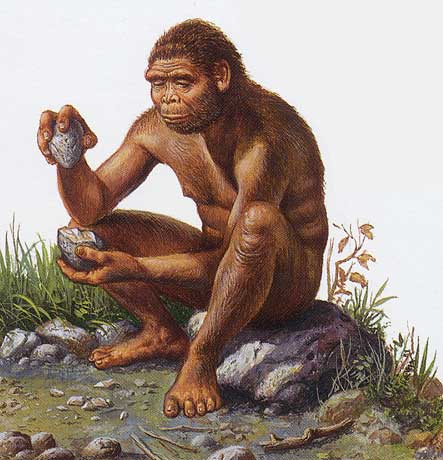
The basis of this template is a color drawing of an ancient human, which in online retellings is associated with Homo habilis, or "handy man." He is crouched among stones, holding one object in front of him and another in a raised hand. The image resembles a popular-science reconstruction of making a stone tool. The drawing itself appeared before the meme captions, but the artist and the original publication of this copy have not been established.
Among the early online traces is a Polish demotivator from March 2010. In the following years, drawings of ancient people were used for jokes about technical bewilderment and generational differences. In February and March 2018 a new Russian-language wave emerged: after the VKontakte outage on February 16, the image was linked to a familiar pastime that had suddenly vanished. A person without a social network seemed to be figuring out from scratch what there was to do at all.
The stones stay in place, the question changes
The ancient human is drawn with thick dark hair, pronounced brow ridges, and a hairy body. He sits on the stones, turned to the left of the picture. In one raised hand is a small gray stone, in the other a larger one. Grass grows on the left, dry stalks are visible on the right, and crumbled stone and a branch lie below. The background is almost white, with no text and no modern devices.
The meme caption makes this focused pose read as bewilderment. The viewer recognizes a familiar feeling: the object is already in hand, but the next step is unclear. The two stones can easily take on the roles of parts to be joined, or of a substitute for an unavailable gadget. The illustration itself keeps its old theme of tool-making, while the caption offers a new everyday situation.
Restarting habits
The name Homo habilis translates as "handy man" and is linked to the use of stone tools. That is why the drawing's comedy arises from a shift in point of view: an activity that once required skill is presented by a modern caption as the loss of familiar competence. The figure becomes a symbol of someone left without a convenient interface. The joke reveals modern users' dependence on habit and prompts.
One variant is built on switching off technology: a person has to act without searching, apps, or automatic settings. Another is built on a new simple task that unexpectedly turns out to be difficult after years of entirely different work. In both cases what matters is the absence of an obvious next step. The stones in the hands make this pause material: everything needed seems to be there, but a ready way of acting does not yet exist.
Bewilderment without a time machine
Next come invented situations. In the first, a person is used to opening a door with a keyless fob but arrives at an old dacha lock with two similar keys. The stones stand for the keys, and the focused gaze for an attempt to remember which one to turn and in which direction. A small change in a familiar action looks like an encounter with ancient technology.
In another invented example, a digital drawing master is handed paper, a compass, and the task of drawing a perfect circle. In an app a single gesture was enough, but now they have to recall how the tool works. The drawing conveys a person pausing between knowing the result and having forgotten how to achieve it.
The third invented variant is making cocoa after an automatic milk frother breaks. The milk, the cup, and the spoon stand right there, but the person keeps looking for the start button. The cave scene exaggerates the few seconds of confusion when an automated procedure unexpectedly turns into a sequence of manual steps.