What is seen in the picture
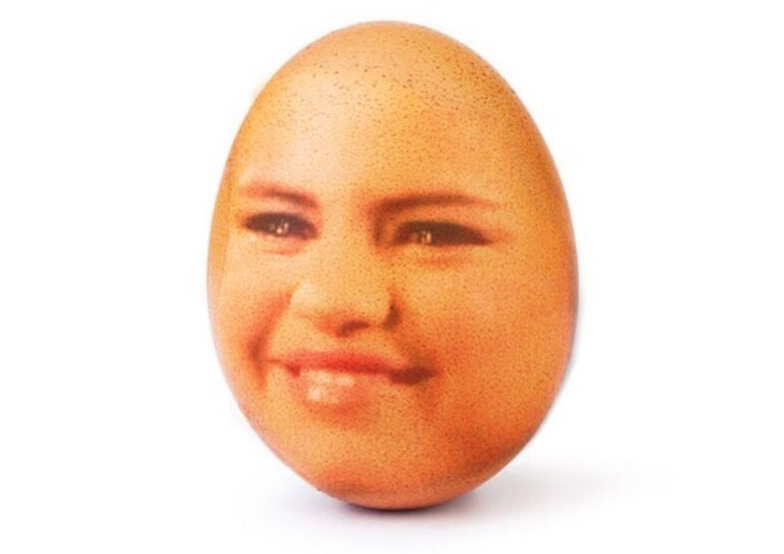
The picture shows a single brown egg in close-up on a white background. The shell has small specks, and the egg stands upright. Over it is superimposed a photographic face: dark eyebrows and eyes, a nose and a smile with lips slightly parted. The face is fitted to the egg's shape, so the features are slightly stretched. Nothing else is in the frame: no caption, no logo.
This is not the original post but a later alteration: the original egg had no face at all. Whose face was used is not discussed here, and there is no need to tie the joke to the person in the picture; the meme works on the image of the egg itself.
The egg that became a record
The source image, a photograph of an ordinary brown egg, appeared on Instagram in early January 2019 in an account created specifically to test whether an extremely simple picture could overtake the platform's most popular post. The previous record was held by a photo of a well-known blogger with her daughter, which had about eighteen million likes. The egg gathered more than that number within a few weeks, and the story reached news feeds around the world.
The exact like counts changed over time, and accounts of the dates and authors differ across retellings, so they are better taken as a rough guide rather than as strict statistics.
Why an empty frame is funny
The main device here is a mismatch of scale. The post consists of one object, with no text and no occasion, yet the result is the attention of millions of people, the kind of attention usually fought for with huge budgets. The effect comes not from a hidden meaning but from a simple juxtaposition: the most modest presentation gets the loudest response.
There is a second layer. It says something about how social networks work: popularity depends on collective attention, not on the quality of the work. The version with a face adds a third layer: a famous image receives a “human” expression, and this ambiguity makes the viewer linger on the picture longer than while scrolling a feed.
Examples of captions and how they work
Below are several captions invented for this template.
“I wrote a book, and it has one line: ‘Hello.’ It went to the top of the bestseller list.” The character speaks of his success seriously, while the amount of text contradicts the result. The viewer expects a long text and gets a single word, and the gap between expectation and fact becomes the joke.
“Promotion budget: zero. Advertising department: an egg.” Here the department itself becomes the joke. The phrase is short, and the contrast works through a sharp shift of scale.
“When there is no news about records in the feed and I still keep scrolling.” The joke is aimed at the viewer: they too want attention, and the egg becomes a mirror of that weakness.
How to use the template
The template suits captions where the character stays still and what changes is the expectation of those around it. The egg does not act, so the comedy comes from the words attributed to it. Captions are better kept short: a long story eats up the frame's main effect.
It is not worth tying the face on the shell to a specific person or to real events from their life. Any caption about a person immediately turns the joke toward a personal story, which is not in the frame. It is better to keep the egg as an abstract symbol of attention and popularity.