Two lists in the same frame
The meme is built as a parallel. The two texts share the same structure: short points describe what people in the locker room are doing. The women's version lists recognisable everyday complaints: tiredness, reluctance to go to PE, discussion of clothes, requests to borrow something from a friend. The men's version describes absurd events: negotiations, fights, allies who appear out of nowhere. Repeating the structure makes the contrast noticeable at once.
What is funny here is that expectation and reality swap places. The text relies on common ideas about behavior in locker rooms, and it is this recognisability that provides the first chuckle. Then the men's half becomes not duller but more absurd, and the reader understands that the parallel exists for the effect, not for conclusions about people. It is a joke about the list genre, not a sociological observation.
Where the text came from
According to reports, the text appeared on VKontakte in early April 2019. The exact date of the first publication has not been established, and the author of the first version is unknown. Different variants circulated at different times, so versions that differ in the order of points and in details are easy to find online.
Over time, the men's part began to use photographs, old memes and random screenshots, and later frames from action films. The template changed along with internet trends, and its meaning rests on the structure rather than on a specific picture. That is why the same device transfers easily to other pairs: office and school, winter and summer, expectation and reality.
Caption examples and how they work
The captions here are built on a list of three points, where each next point is a little more absurd than the previous one.
“Women's locker room: tired, PE was cancelled, lend me your concealer.” The first two points sound familiar, and the reader relaxes. The third is unexpectedly mundane and makes the complaint recognisable, and therefore funny.
“Men's locker room: discussed the plan, agreed with the guard, left through the window.” Each step looks businesslike, and the ending shifts the tone to absurd. Escalation does the work: the seriousness of the plan collapses on one detail.
“Men's locker room: called in reinforcements from the next group and never got changed.” The pause before the outcome creates an expectation of a major fight, and the conclusion turns out to be trivial. The laughter arises from the mismatch between the scale of the actions and the result.
“Women's locker room: found out who came in what and decided that PE can wait.” The text again relies on a recognisable complaint, but the ending sounds like a decision rather than a problem. That is why the caption looks calm and confident.
The picture and the sign with hieroglyphs
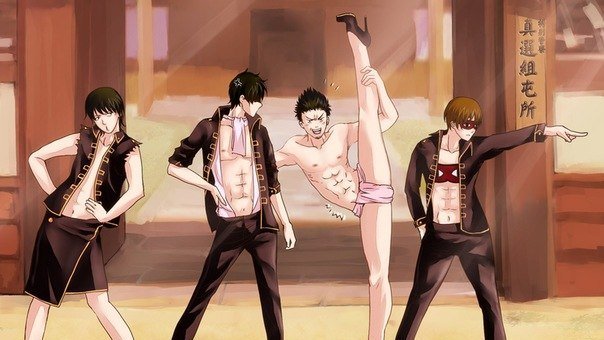
The illustration shows four characters in black uniforms with gold trim standing in front of a wooden entrance. On the left, one character has a hand on his hip; in the center, another, shirtless, has raised a leg high; on the right, another has extended an arm to the side. The sign on the right reads 真選組屯所, which marks the headquarters of the Shinsengumi squad from the anime Gintama.
Judging by the style and the sign, the illustration can be classified as fan art of this anime. The artist is unknown. A link between the picture and the meme's text is not confirmed: among the known variants of the men's part are photographs, old memes and film frames, but not anime. The image should therefore be considered a separate picture that accompanies the meme, not part of the story of the text itself.
How to apply the template
The text works better in pairs: two paragraphs one after the other, with the same rhythm. If you place a picture next to it, the contrast between image and text becomes an extra reason to smile.
Do not turn the text into a reproach aimed at one side. It is funny when the contrast is absurd, not when it becomes an accusation. It is handy to keep the points short and end on the most nonsensical one.