The ad promised a journey into the OASIS
Ready Player One is a 2018 science fiction film directed by Steven Spielberg, based on Ernest Cline’s novel. The protagonist, Wade Watts, is played by Tye Sheridan. In the film’s world, people spend their time in the virtual OASIS, and a contest left behind by its creator turns into a great race for the inheritance. The advertising composition combines cramped urban life with the promise of a vast other world.
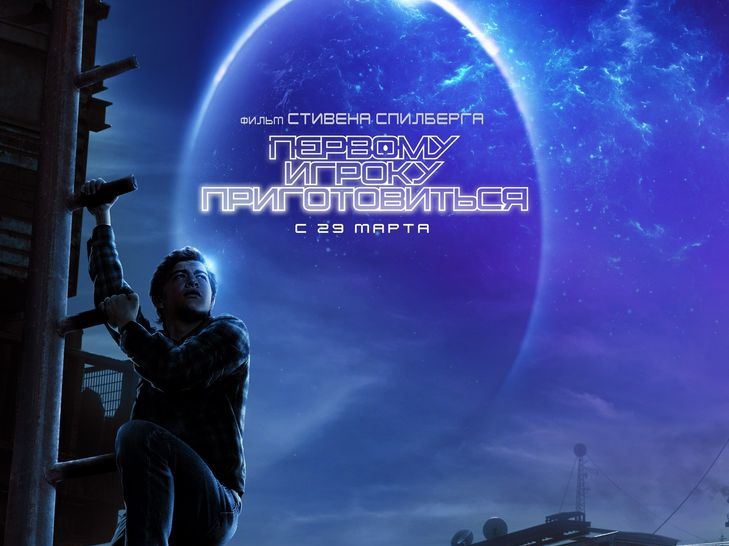
On the blue Russian-language poster, the hero holds on to a staircase by a building on the left and looks up. Most of the space is taken by a glowing oval in the sky; at the bottom right, rooftops and antennas are visible. The title is set in white geometric letters, with Spielberg’s name above it and “from March 29” below. These elements belong to the film’s release advertising and do not date the creation of this particular image.
The leg caught attention away from the fantasy world
In December 2017, discussion of the full advertising composition focused on the hero’s body proportions. Users felt that one leg was too long, and they began making alterations, stretching it further or inventing explanations for the unusual anatomy. Other participants, including Captain Disillusion, argued with perspective-based reasoning. The dispute over how the image was perceived became part of its popularity.
The unusual proportions seemed convincing to some viewers and implausible to others. The comic detail lies above all in how the audience read the pose. In the image presented here, the bottom of the poster is cropped, and the lower end of the stretched leg is not shown. The original composition with the staircase is preserved, but this is not a finished user edit in which the limb was deliberately enlarged to an impossible size.
How a small detail changes the meaning of a big poster
The poster invites the viewer to look at the title and the fantastic sky. The meme redirects attention to the body at the edge of the frame. As soon as the figure starts to seem strange, the solemn advertising scale changes function: the vast world turns into a backdrop for a very long leg. The shift is funny because a secondary detail suddenly becomes the main event of the image.
Edits can literally lengthen the leg or change the caption, leaving the picture nearly intact. In the second case, it is enough to present the unusual proportion as a special virtue of the hero: he can easily reach a distant step or step over obstacles. The pathos of the fantasy adventure is preserved, but its cause becomes everyday convenience. The viewer simultaneously recognizes the film’s serious advertising and sees how its promise has been redirected.
Three imaginary adventures of a long leg
For example, an invented caption could declare the hero a man who turns off the light without getting out of bed. The staircase and blue sky remain in place, but the scale of the ability shrinks sharply. Instead of saving the virtual world, the joke offers a dream of lazy domestic convenience; the solemn design makes the modest goal especially funny.
In another alteration, the advertising text would promise the ideal walking companion, able to step over any puddle. The imagined long leg solves an ordinary urban problem, and the glowing oval looks like excessive scenery for a walk after rain. The joke keeps the theme of movement and changes only the size of the task.
A third variant would present the poster as an announcement about a person who always catches the last bus with a single step. The transport scene uses the same exaggeration and turns the fantastic hero into a winner of the daily timetable. All three examples depend on the familiar impression of proportions; without it, these would be ordinary everyday wishes. The poster gives them a spectacular form and an already prepared occasion for hyperbole.