Origin of the inscription
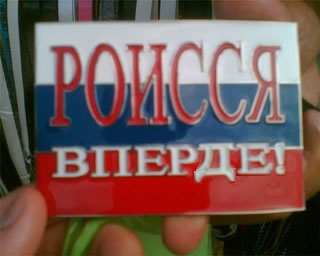
It was not possible to establish the exact origin of this inscription, so the information here relies on general knowledge of this type of merchandise and on what's visible in the image itself. Judging by its appearance, we're looking at a souvenir pin or magnet: raised red letters with an outline sit on a flat plate where white, blue, and red stripes form the Russian flag. Items like this were sold at kiosks, markets, and tourist stalls in the 2000s, when state symbols became a common feature of mass-market merchandise.
The phrase "Russia, forward!" is a widely known sporting and rallying slogan heard from the stands and in mass campaigns. On its own it's neutral, but on a cheap souvenir its grandiosity easily turns into an object of self-mockery. The distortion "Roissya" creates the impression of a childish or sloppy inscription, while the word "vperde" sounds like the crude everyday word for "farting." So, layered over the patriotic call, an intentionally crude joke appears, and that is what makes the inscription memorable.
How the meme spread
The meme gained popularity around 2008, when forums and blogs began collecting photos of tacky patriotic merchandise. Users shared pictures of magnets, T-shirts, mugs, and pins, captioning them with short ironic comments. The label "roissya vperde" quickly became a tag for this whole category of images, and many participants in the discussions used it without needing to explain what it meant.
It's worth noting that the manufacturers never intended a joke: they simply copied popular slogans and tried to stand out with bright colors. Viewers, however, saw in such items a mix of pride and awkwardness that fit internet irony perfectly. The photo was shot in an ordinary retail setting: the pin is held in someone's hand against a patterned fabric backdrop, which underscores the item's mass-produced, low-cost nature.
Ways it's used
In conversation, the phrase is used to refer to any demonstrative pride expressed crudely or with excessive pomp. It's most often said in an ironic tone: "roissya vperde" means roughly "we're proud, but we get that it's funny." The speaker isn't necessarily criticizing the country; rather, they're pointing to the gap between official pomp and the everyday crudeness that pervades mass-produced souvenirs.
In colloquial speech there are other distortions of the same slogan, but the general principle stays the same: the altered inscription becomes a marker for those who recognize the joke. This signal shows other people that it's fine to laugh at the symbolism without thereby giving up one's own belonging to the culture in which that symbolism exists.
Cultural context
The meme belongs to a line of humor often called the "kitsch" of internet culture. In it, objects of mass symbolism are simultaneously admired and mocked: postcards, flags, ad slogans, and souvenirs become material for collections and jokes. For a Russian-speaking reader this kind of irony is quite familiar, and "roissya vperde" has become one of the recognizable examples of this genre.
Classifying the meme as political is appropriate only in a broad sense: the meme concerns state symbolism but contains no assessment of specific politicians, decisions, or events. It's therefore more accurate to treat it as everyday humor about a patriotic souvenir rather than as political satire. The object of mockery is the aesthetics and manner of selling the symbols, not the people those symbols represent.
Takeaway
Today "roissya vperde" is understood as an established ironic reference. The image has survived in meme archives and continues to appear in discussions of souvenir culture. The date of the photo's first publication and the author's name remain unknown, so the meme's history should be treated as a reconstruction from indirect evidence rather than a precisely confirmed chronicle.